DAILY YOGA · Adho Mukha Svanasana
Downward-Facing Dog
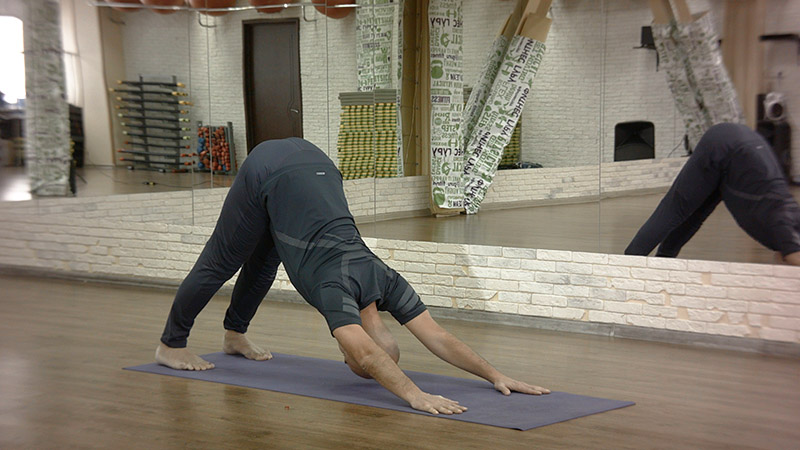
Adho Mukha Svanasana — Downward-Facing Dog — is the most recognised shape in modern yoga. It is a gentle, whole-body inversion that lengthens the spine, stretches the backs of the legs, and builds quiet strength in the arms and shoulders. Named after the way a dog stretches on waking, it appears in almost every Surya Namaskar and vinyasa flow as a resting, resetting posture.
Name meaning: From adhas (down), mukha (face), śvāna (dog) and āsana (posture) — literally "downward-facing dog posture", named for the way a dog stretches on waking.
Classification: Asana — a mild inversion, usually grouped with standing/forward-bend poses; a key link in Surya Namaskar and vinyasa flows.
Tradition & origin: Despite its familiarity, the name is not found in the medieval hatha-yoga texts. A related repeated posture, Gajāsana (Elephant Pose), appears in the 18th-century Haṭhābhyāsapaddhati. The pose became central to modern practice through the Surya Namaskar popularised in the 1920s–30s and the teaching of Krishnamacharya, whose students B. K. S. Iyengar and Pattabhi Jois spread it worldwide. It is best understood as modern postural yoga rooted in older movement traditions, not an ancient named asana.
This guide was drafted with the help of AI and reviewed by us. It is for general education only and is not medical or professional advice. It may contain errors. Please practise mindfully, listen to your body, and consult a qualified yoga teacher or doctor for anything specific. Spotted an error? Tell us in the comments below.
How to do it — step by step
- 1Begin on hands and knees, wrists a little in front of the shoulders, knees under the hips.
- 2Spread the fingers wide and press the whole palm down, especially the thumb-and-index mound.
- 3Tuck the toes, exhale, and lift the knees away from the floor.
- 4Send the hips up and back so the body forms an inverted "V".
- 5Keep the knees softly bent at first; lengthen the spine rather than forcing the heels down.
- 6Let the head hang freely between the arms, ears in line with the upper arms.
- 7Gradually straighten the legs and reach the heels toward the floor without rounding the back.
Breath & hold
Breathe steadily through the nose. Take 5–10 slow breaths, or hold for 30–60 seconds. In a flow, move into it on an exhale and rest here for a few breaths before continuing.
Benefits
- ✓Lengthens the spine and decompresses the lower back.
- ✓Stretches hamstrings, calves and the arches of the feet.
- ✓Strengthens the arms, shoulders and wrists.
- ✓Gently reverses blood flow, which can feel calming and refreshing.
- ✓Relieves stiffness after sitting for long hours.
🪔 The traditional / desi way
- In traditional Indian teaching this is a "reset" posture — old-school gurus use it between stronger asanas to let the breath settle.
- A common desi cue: imagine a langur (monkey) or a dog waking and pushing the ground away — the stretch should feel like a yawn through the whole back.
- Villages practising Surya Namaskar at sunrise flow through this shape twice each round; the morning air and empty stomach are considered part of the practice.
Common mistakes
- ✕Rounding the upper back to force the heels down — keep the spine long and bend the knees instead.
- ✕Dumping weight into the wrists — press evenly through the whole hand.
- ✕Hunching the shoulders up by the ears — draw them away from the neck.
- ✕Holding the breath while trying to "get deeper".
Modifications & props
- 🧩Keep knees bent generously to protect the lower back.
- 🧩Practise with hands on a wall or chair (half dog) if the full pose is too intense.
- 🧩Place a folded blanket under the heels for a sense of support.
Muscles & anatomy
- 💪Lengthening (stretched): hamstrings, gastrocnemius and soleus (calves), and the plantar fascia of the feet.
- 💪Working (strengthened): deltoids, serratus anterior and the muscles around the shoulder blades; triceps stabilise the elbows.
- 💪Core: the abdominals gently support the spine; wrist and forearm muscles stabilise the base.
What you may feel
- 🫧Normal: a broad stretch up the backs of the legs, effort in the shoulders and arms, and length through the spine.
- 🫧Normal: mild trembling in the arms when held — a sign the muscles are working.
- 🫧Warning sign: sharp wrist pain, pinching in the shoulders, or pressure in the head or eyes — come down and modify.
Variations to grow into
Three-legged dog: keep the shape and lift one straight leg behind you, hips level, for a few breaths before switching.
Extended/handstand preparation: walk the feet slightly in and shift the shoulders further over the wrists to build overhead strength. Only explore this with a stable, pain-free base and, ideally, a teacher's eye.
Using props
- 🧱Yoga blocks under the hands to reduce wrist load and help a longer spine.
- 🧱A wall or chair for "half dog" — hands on the support, body in an L-shape.
- 🧱A folded blanket or rolled mat under the heels for a sense of grounding.
Warm-up & counterpose
- A few rounds of Cat–Cow to free the spine.
- Table-top to short "puppy" stretches to open the shoulders.
- Ankle and wrist circles.
- Child's Pose (Balasana) to release the shoulders and lower back.
- A gentle standing forward fold or a soft backbend such as low Cobra to balance the shape.
Supporting exercises
Why: Warms and mobilises the spine and shoulders before loading them.
How: On hands and knees, alternate rounding and gently arching the spine with the breath for 6–8 slow rounds.
Why: Prepares the wrists for weight-bearing and reduces strain.
How: Circle the wrists both ways, then gently stretch the palms and forearms for 30–60 seconds each.
Why: Eases tight hamstrings so the spine can lengthen in the pose.
How: Hinge forward with a long spine over slightly bent knees; hold 20–30 seconds.
Progression path
Begin with hands on a wall or chair (half dog), then a short-hold bent-knee version on the floor, gradually straightening the legs and lengthening the hold as the hamstrings and shoulders open. There is no need to force the heels down.
Who it suits — and who should modify
- ✓Most beginners, with knees bent as needed.
- ✓People who sit for long hours and want to decompress the spine.
- ✓Intermediate practitioners using it as an active rest between poses.
- ✓Runners and athletes stretching the backs of the legs (build up gradually).
- !Relative caution: carpal-tunnel syndrome or wrist injury — try fists, a wedge, or forearm (Dolphin) instead.
- !Relative caution: uncontrolled high blood pressure and glaucoma or other raised-eye-pressure conditions — the head-below-heart position may not suit you; ask your clinician.
- !Modify: late pregnancy — take the feet wider and shorten the hold, or use a wall.
- !Stop if you feel pressure in the head, ears or eyes, and rest in Child's Pose.
When to practise
Excellent in the morning to wake the body, and any time after long sitting. As part of Surya Namaskar it is traditionally done on an empty stomach.
Safe to practise daily. In a flow it recurs many times; as a standalone hold, a few 30–60s rounds is plenty.
Traditional view vs. modern evidence
Used as a "reset" between stronger asanas and as a rejuvenating stretch; 20th-century teachers such as Iyengar also credited it with relieving fatigue.
The exact pose is not named in the medieval hatha texts; a related repeated posture (Gajāsana) appears in the 18th-century Haṭhābhyāsapaddhati.
Recognised as an effective stretch for the posterior legs and a strengthener for the shoulders; broad yoga programmes show modest benefits for back pain and wellbeing.
Specific organ or "detox" claims are not supported by evidence.
Evidence at a glance
Regular yoga practice can offer a small benefit for chronic low-back stiffness and function.
Reviews summarised by the US NCCIH find a modest benefit for low-back pain from yoga overall (not this pose in isolation).
The pose stretches the hamstrings and calves and builds shoulder strength.
A straightforward, well-described biomechanical effect of the shape.
It "reverses blood flow" for special detox or healing effects.
Beyond the pleasant feeling of a mild inversion, specific health claims here are not established.
Myths vs. reality
✕ Myth: Your heels must touch the floor to do it correctly.
✓ Reality: Heel height depends on calf and hamstring length; a long spine matters more than flat heels. Keep the knees bent as needed.
✕ Myth: Downward Dog detoxes the organs.
✓ Reality: There is no evidence it "detoxes" anything. It does stretch the legs and build shoulder strength, which is benefit enough.
⚠️ Cautions
- Late pregnancy, carpal-tunnel or wrist injury, and uncontrolled high blood pressure — practise with guidance or choose an alternative.
- If you feel pressure in the head or eyes, come down and rest in Child's Pose.
Frequently asked questions
Why do my heels not touch the floor?
That is completely normal, especially for beginners and anyone with tight calves. The heels reaching the floor is not the goal — a long spine is. Keep the knees bent and let the heels lower over weeks and months.
How long should I hold Downward Dog?
Beginners can hold 15–30 seconds and build up to a minute. In a flowing practice it is often just a few breaths at a time.
Is Downward Dog good for back pain?
Many people find it eases mild stiffness because it lengthens the spine, but if you have an acute back injury, check with a teacher or physician first.
Key takeaways
- ⭐A mild whole-body inversion that stretches the backs of the legs and strengthens the shoulders.
- ⭐Keep the knees bent and the spine long — flat heels are not the goal.
- ⭐Modern postural yoga, not an ancient named asana; central to Surya Namaskar.
- ⭐Ease off with wrist, blood-pressure or eye-pressure concerns, and rest in Child's Pose if the head feels full.
References
- NCCIH — Yoga: What You Need To Know · Government health body (public domain)
- Wikipedia — Downward Dog Pose (etymology & origins, sourced to Mallinson & Singleton, Roots of Yoga) · Encyclopaedia, scholarly-sourced
Sources are provided for further reading; always consult a qualified teacher or clinician for personal guidance.
📝 Your private notes
Saved only on this device — jot down what helped.
💬 Improvements, corrections & suggestions
Found an error or have a better cue? Share it — practitioners help make each guide more accurate.
No comments yet — be the first to help improve this guide.