DAILY YOGA · Astavakrasana
Eight-Angle Pose
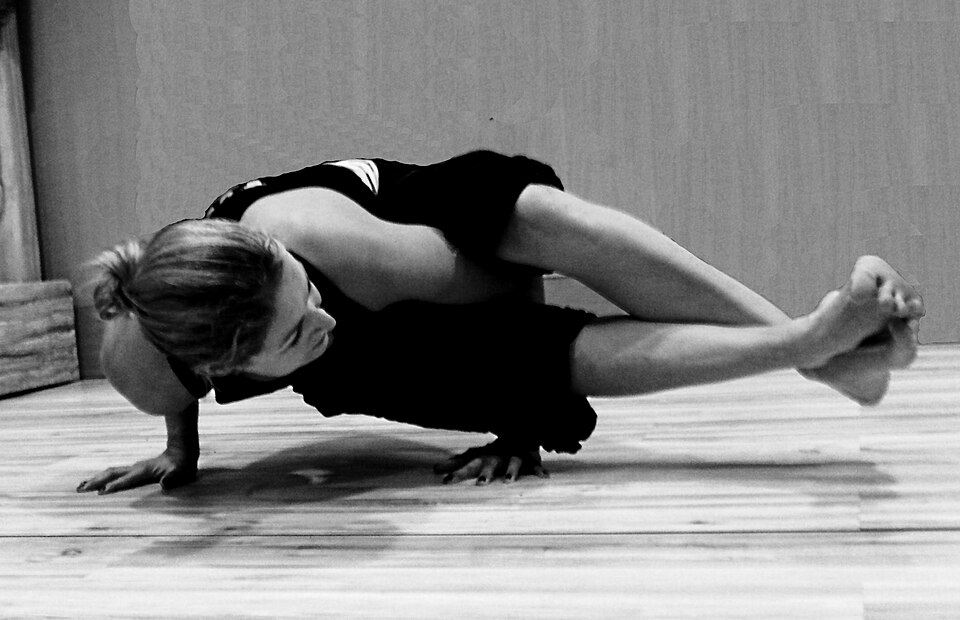
Astavakrasana — Eight-Angle Pose — is an advanced twisting arm balance where the legs hook around one arm and extend to the side while the body lowers between the hands. Named after the sage Ashtavakra (born with eight bends in his body), it demands core strength, a twist and fearless commitment.
Name meaning: From aṣṭa meaning "eight", vakra meaning "bent/curved", and āsana — the "eight-angle posture". Also dedicated to the sage Astavakra, said to be born bent in eight places.
Classification: Asana — an advanced twisted hand-balance.
Tradition & origin: Eight-Angle Pose is modern: it was unknown in hatha yoga until the 20th century (Iyengar's Light on Yoga). The scholar Norman Sjoman notes it appears in the 1896 gymnastics manual Vyayama Dipika, suggesting Krishnamacharya adopted it into Mysore yoga. It carries a sage's name but is a modern pose.
This guide was drafted with the help of AI and reviewed by us. It is for general education only and is not medical or professional advice. It may contain errors. Please practise mindfully, listen to your body, and consult a qualified yoga teacher or doctor for anything specific. Spotted an error? Tell us in the comments below.
How to do it — step by step
- 1Sit with the right leg over the right shoulder (hook the knee high on the arm).
- 2Cross the left ankle over the right and squeeze the legs together.
- 3Plant both palms on the floor, shoulder-width.
- 4Bend the elbows straight back and lean the chest forward.
- 5Lift the hips and extend the legs out to the right side.
- 6Twist the torso and straighten the arms toward Chaturanga-depth.
- 7Gaze forward; then lift up and release. Switch sides.
Breath & hold
Breathe steadily; hold 10–20 seconds each side. Do not hold the breath.
Benefits
- ✓Strengthens the arms, wrists, shoulders and core.
- ✓Deepens spinal rotation.
- ✓Builds balance, focus and confidence.
- ✓Integrates twist and arm balance together.
🪔 The traditional / desi way
- Named for the sage Ashtavakra ("eight bends"), whose wisdom transcended his crooked body — a reminder that steadiness is inner, not outer.
- Traditional cue: hook the leg high on the arm and squeeze the ankles tight; the grip of the legs is what makes the lift possible.
Common mistakes
- ✕Hooking the leg too low on the arm.
- ✕Not squeezing the ankles together.
- ✕Looking down instead of forward.
Modifications & props
- 🧩Practise Bakasana (Crow) and Side Crow first for the arm-balance base.
- 🧩Keep the toes on a block to find the lean and squeeze.
Muscles & anatomy
- 💪Strongly works the wrists, arms, shoulders and deep core.
- 💪The obliques and the tight leg-grip around the arm hold the shape.
- 💪The hooked, squeezing legs and a forward lean create the balance.
What you may feel
- 🫧Normal: intense arm and core effort with a firm leg squeeze around the upper arm.
- 🫧Warning sign: wrist pain or the legs sliding off — hook the knee higher, squeeze harder, or come down.
Variations to grow into
Keep the toes on a block to find the lean and squeeze before lifting fully.
Transition in and out via Side Crow, or flow from Eight-Angle into Chaturanga — for strong, experienced practitioners.
Using props
- 🧱Blocks flat under the hands to lengthen the arms.
- 🧱A block under the feet to find the lift.
Warm-up & counterpose
- Wrist mobility, Crow, Side Crow and gentle twists to warm up.
- A wrist counter-stretch, then Seated Forward Bend or Child's Pose.
Supporting exercises
Why: Builds the twist and arm-balance base directly.
How: Balance in the twisted Crow with both thighs on one upper arm.
Why: Strengthens the deep core the balance needs.
How: Hold a V-shape on the sitting bones for 20–30 seconds.
Progression path
Master Crow and Side Crow; hook one leg high on the upper arm, cross the ankles and squeeze, lean forward and straighten the legs to the side.
Who it suits — and who should modify
- ✓Advanced practitioners comfortable with Crow and Side Crow.
- ✓Those with strong wrists, arms and core and a confident twist.
- ✓People building a repertoire of twisted arm balances.
- !Wrist, shoulder or elbow injury — build strength first or skip.
- !Pregnancy — avoid the deep twist and compression.
- !Recent abdominal or wrist surgery — avoid.
When to practise
In the stronger, warmed part of a practice, after arm-balance preparation.
A couple of times a week; build gradually.
Traditional view vs. modern evidence
The sage Astavakra “bent in eight places”; a bound, twisting balance.
Not in the medieval texts; a modern pose (Light on Yoga; 1896 gymnastics manual).
Valued as a challenging twisted arm balance that builds strength and focus.
Organ-toning claims are not established.
Evidence at a glance
Eight-Angle builds wrist, arm, shoulder and core strength and balance.
Consistent with the biomechanics of a twisted hand-balance.
It tones or heals specific abdominal organs.
A traditional-style claim offered without supporting evidence.
Myths vs. reality
✕ Myth: The sage Astavakra means the pose is ancient.
✓ Reality: The name honours the sage, but the pose itself is modern (20th-century), likely adopted from gymnastics.
✕ Myth: You need huge upper-body strength.
✓ Reality: The tight leg-grip, a forward lean and a firm twist do most of the work; leverage matters as much as strength.
⚠️ Cautions
- Wrist injury or carpal tunnel — build strength first and practise cautiously. Pregnancy — avoid.
Frequently asked questions
My legs slide off my arm — why?
Hook the knee higher up the upper arm and squeeze the ankles firmly together — the tight leg grip is the secret to the balance.
What should I learn first?
Get comfortable with Crow and Side Crow; they build the shoulder and core strength Eight-Angle needs.
Key takeaways
- ⭐An advanced twisted hand-balance — the tight leg-grip and forward lean create it.
- ⭐Master Crow and Side Crow first; hook the knee high and squeeze the ankles.
- ⭐A modern pose bearing the sage Astavakra's name.
- ⭐Avoid with wrist/shoulder issues, pregnancy or recent surgery.
References
- Wikipedia — Astavakrasana (origins, Vyayama Dipika, Light on Yoga) · Encyclopaedia, scholarly-sourced
- NCCIH — Yoga: What You Need To Know · Government health body (public domain)
Sources are provided for further reading; always consult a qualified teacher or clinician for personal guidance.
📝 Your private notes
Saved only on this device — jot down what helped.
💬 Improvements, corrections & suggestions
Found an error or have a better cue? Share it — practitioners help make each guide more accurate.
No comments yet — be the first to help improve this guide.