DAILY YOGA · Chaturanga Dandasana
Four-Limbed Staff
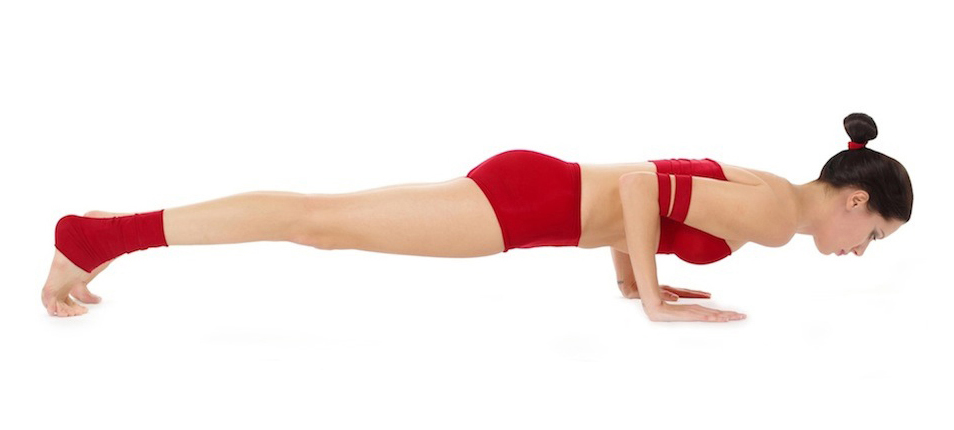
Chaturanga Dandasana — Four-Limbed Staff Pose — is the low, hovering "push-up" that links movements in a vinyasa flow. Held as one strong, straight line just above the floor, it builds serious upper-body and core strength — and it is one of the most commonly rushed and mis-done poses, so form matters.
Name meaning: From catur meaning "four", aṅga meaning "limb", daṇḍa meaning "staff", and āsana meaning "posture" — the "four-limbed staff posture", the body held straight and low like a staff on four points.
Classification: Asana — a low-plank arm/core strengthener; a key link in vinyasa flow and Surya Namaskar.
Tradition & origin: Chaturanga is modern: it was unknown in hatha yoga until 20th-century texts (Iyengar's Light on Yoga), though a related move appears among the "very old" danda exercises in the 1896 gymnastics manual Vyayama Dipika. It became foundational to modern practice through Krishnamacharya's Mysore teaching and his pupils Pattabhi Jois and Iyengar. Present it as modern postural yoga.
This guide was drafted with the help of AI and reviewed by us. It is for general education only and is not medical or professional advice. It may contain errors. Please practise mindfully, listen to your body, and consult a qualified yoga teacher or doctor for anything specific. Spotted an error? Tell us in the comments below.
How to do it — step by step
- 1From Plank, shift the weight forward onto the balls of the feet.
- 2Keep the body in one straight line from crown to heels.
- 3Exhale and bend the elbows straight back, hugging them to the ribs.
- 4Lower only until the shoulders are level with the elbows (elbows ~90°).
- 5Keep the shoulders from dipping below the elbows.
- 6Firm the core and thighs; gaze slightly forward.
- 7From here, flow to Up Dog, or lower the knees to rest.
Breath & hold
Exhale as you lower; do not hold the breath. It is usually a brief transition, not a long hold.
Benefits
- ✓Strengthens the arms, wrists, shoulders and core.
- ✓Builds the control needed for arm balances.
- ✓Improves whole-body stability and stamina.
- ✓Teaches precise, protective shoulder alignment.
🪔 The traditional / desi way
- Chatur-anga = "four limbs", danda = "staff": the body held straight and firm as a staff, balanced on four points.
- Traditional focus: strength with restraint. Better to lower halfway with good form than to collapse all the way down.
Common mistakes
- ✕Dropping the chest below the elbows and sagging the shoulders forward.
- ✕Letting the hips pike up or sag down.
- ✕Flaring the elbows out wide instead of hugging them to the ribs.
- ✕Rushing through it and losing the straight line.
Modifications & props
- 🧩Lower the knees to the floor (knees-chest-chin style) to build strength safely.
- 🧩Lower only halfway while you develop control.
Muscles & anatomy
- 💪Working: the triceps, shoulders (deltoids, serratus, rotator cuff) and the deep core hold the low, straight line.
- 💪The glutes and quadriceps keep the hips level and the legs firm.
- 💪The elbows stay hugged along the ribs (not flared) to protect the shoulders.
What you may feel
- 🫧Normal: strong effort in the arms, shoulders and core, held for just a breath or two in flow.
- 🫧Warning sign: shoulder pinching or the chest sinking below the elbows — halt at 90°, hug the elbows in, or drop the knees.
Variations to grow into
Flow Plank → Chaturanga → Up Dog smoothly with the breath, keeping the elbows in and the descent controlled.
Lower slowly from Plank with straight legs and pause at 90° before flowing on — greater control and strength.
Using props
- 🧱Knees down to reduce load while building strength.
- 🧱A rolled blanket or block under the chest to learn the stopping height.
Warm-up & counterpose
- Plank and wrist mobility.
- A few Cat–Cow and Down-Dog to plank shifts.
- Upward Dog or Cobra to open the front body after the descent.
- Child's Pose to release the shoulders.
Supporting exercises
Why: Builds the shoulder and triceps strength with less load.
How: From knees-down plank, lower halfway with elbows hugging the ribs, 6–8 times.
Why: Builds the core and shoulder stability the descent needs.
How: Hold a straight-line plank for 20–40 seconds.
Progression path
Begin with knees-down half-lowers, then full knees-down Chaturanga, then the full pose with a controlled stop at shoulder height — never collapsing lower.
Who it suits — and who should modify
- ✓Intermediate practitioners with shoulder and core strength.
- ✓Beginners, using the knees-down (knees-chest-chin) version to build strength.
- ✓Those flowing through vinyasa who want a strong transition.
- !Modify: wrist or shoulder injury — use knees-down or skip; stop if the shoulders pinch.
- !Relative caution: lower-back pain — keep the core engaged and hips level, or drop the knees.
- !Never lower past shoulder height — collapsing the shoulders is a common injury path.
When to practise
Any time once warm; it recurs throughout vinyasa flows.
Safe most days for healthy shoulders; use knees-down while building strength.
Traditional view vs. modern evidence
A strong staff-like transition; the modern emphasis is control and elbows hugging the ribs.
Not in the medieval hatha texts; modern (via Krishnamacharya, from danda-style exercises).
Valued as a foundational strength transition in vinyasa; form matters for shoulder safety.
Beyond strength, specific medical claims are limited.
Evidence at a glance
Chaturanga builds triceps, shoulder and core strength.
Consistent with exercise-physiology evidence for controlled lowering (eccentric) push-type work.
Repeated poor-form Chaturanga is linked to shoulder overuse issues.
Widely observed by teachers/clinicians; keeping the elbows in and stopping at 90° is protective.
Myths vs. reality
✕ Myth: Lower all the way to the floor like a push-up.
✓ Reality: Stop when the shoulders are level with the elbows (~90°); dropping lower collapses and can injure the shoulders.
✕ Myth: Chaturanga is an ancient asana.
✓ Reality: It is modern (20th century, via Krishnamacharya), not a medieval hatha pose.
⚠️ Cautions
- Wrist or shoulder injury — build strength gradually and use the knees-down version. Stop if the shoulders pinch.
Frequently asked questions
How low should I go?
Only until the shoulders are level with the elbows (about 90°). Going lower collapses the shoulders and risks injury.
My shoulders hurt — why?
Usually the chest drops too low or the elbows flare out. Keep the elbows hugging the ribs and stop at shoulder-height; use knees-down to build strength.
Key takeaways
- ⭐A low-plank strength transition for the arms, shoulders and core.
- ⭐Stop at shoulder height (~90°) with elbows hugging the ribs — never collapse lower.
- ⭐A modern pose (Krishnamacharya), not a classical asana.
- ⭐Use knees-down to build strength and protect the shoulders.
References
- Wikipedia — Chaturanga Dandasana (etymology & origins) · Encyclopaedia, scholarly-sourced
- NCCIH — Yoga: What You Need To Know · Government health body (public domain)
Sources are provided for further reading; always consult a qualified teacher or clinician for personal guidance.
📝 Your private notes
Saved only on this device — jot down what helped.
💬 Improvements, corrections & suggestions
Found an error or have a better cue? Share it — practitioners help make each guide more accurate.
No comments yet — be the first to help improve this guide.