DAILY YOGA · Garudasana
Eagle Pose
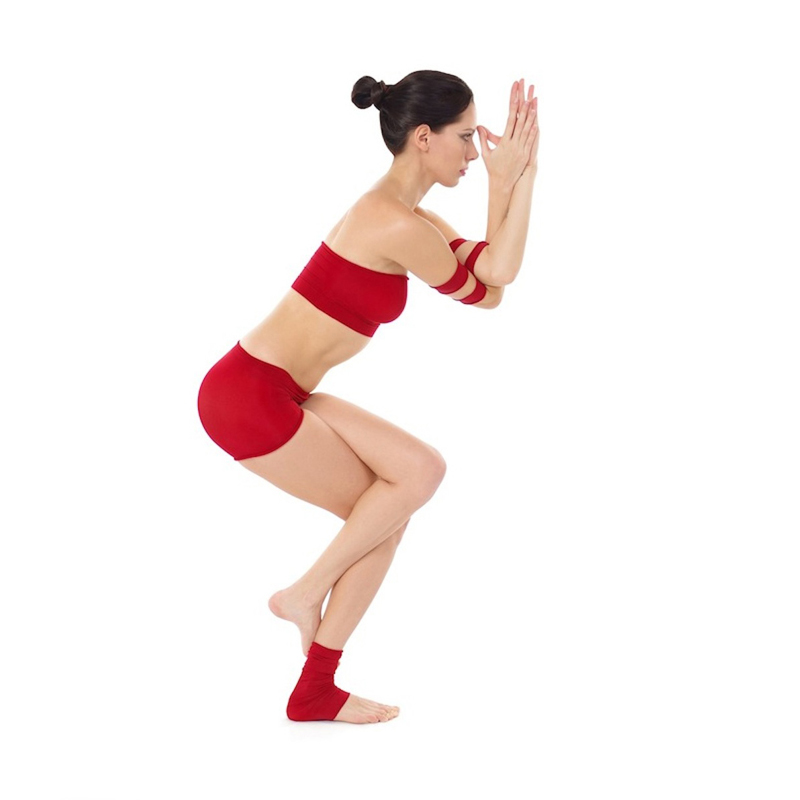
Garudasana — Eagle Pose — is a standing balance where the arms and legs wrap around each other, then sink low. Named after Garuda, the mighty eagle-mount of Vishnu, it builds focus and balance while opening the upper back and outer hips.
Name meaning: From Garuḍa, the eagle-like king of birds and mount of Vishnu, and āsana meaning "posture" — the "eagle posture". The pressed palms are said to resemble the eagle's beak.
Classification: Asana — a standing balance pose with wrapped arms and legs.
Tradition & origin: The name Garudasana is old but has meant different poses: the late-17th-century Gheranda Samhita (2.37) gives it to a seated pose, and the 19th-century Sritattvanidhi to a one-legged balance closer to Tree Pose. The modern wrapped-limb Eagle is described in Light on Yoga (20th century). So the name is traditional; this particular balance is modern.
This guide was drafted with the help of AI and reviewed by us. It is for general education only and is not medical or professional advice. It may contain errors. Please practise mindfully, listen to your body, and consult a qualified yoga teacher or doctor for anything specific. Spotted an error? Tell us in the comments below.
How to do it — step by step
- 1Stand in Tadasana and bend the knees slightly.
- 2Cross the right thigh over the left; hook the right foot behind the left calf if possible.
- 3Cross the left arm over the right at the elbows, then wind the forearms so the palms meet.
- 4Lift the elbows to shoulder height and reach the fingers up.
- 5Sink the hips down and lengthen the spine.
- 6Fix the gaze on a steady point and breathe.
- 7Unwind slowly and repeat on the other side.
Breath & hold
Breathe smoothly; hold 15–30 seconds each side. A steady breath steadies the balance.
Benefits
- ✓Improves balance and concentration.
- ✓Opens the upper back, shoulders and outer hips.
- ✓Strengthens the legs, ankles and feet.
- ✓Encourages focus and a quiet mind.
🪔 The traditional / desi way
- Garuda, the divine eagle, is a symbol of power, vision and devotion — the wrap gathers the body inward like folded wings before flight.
- Traditional cue: root down and gather in — the wrapping creates focus, the low sink builds strength.
Common mistakes
- ✕Collapsing the chest and dropping the elbows.
- ✕Standing tall instead of sinking the hips.
- ✕Losing the gaze and wobbling.
Modifications & props
- 🧩Rest the top toes on the floor instead of hooking behind the calf.
- 🧩Hug the opposite shoulders if the arms will not wind fully.
Muscles & anatomy
- 💪Working: the standing-leg ankle, calf, quadriceps and glute stabilise; the core keeps the torso upright.
- 💪Stretched: the upper back and shoulders (arm wrap) and the outer hips (leg wrap).
- 💪Balance relies on constant small adjustments from the foot and ankle.
What you may feel
- 🫧Normal: active standing-leg effort, a stretch across the upper back and outer hips, and focused steadiness.
- 🫧Warning sign: knee pain from the leg wrap, or wobbling that unbalances you — use a kickstand and stay near support.
Variations to grow into
Hook the top foot behind the standing calf and sit a little lower, lifting the elbows to deepen the upper-back stretch.
Fold forward over the wrapped legs (elbows toward the knee) for a bigger balance and upper-back challenge.
Using props
- 🧱A wall at your side or back for support while learning.
- 🧱A kickstand top toe on the floor, and hugging the shoulders, as easier options.
Warm-up & counterpose
- Balance work (Tree) and gentle shoulder/upper-back openers.
- Ankle mobility.
- Return to Mountain Pose and feel both feet even before switching sides.
- A gentle chest-opener to release the wrapped shoulders.
Supporting exercises
Why: Builds the single-leg balance Eagle needs.
How: Balance on one leg with a fixed gaze, 20–30 seconds each side.
Why: Opens the upper back for the arm wrap.
How: Draw one arm across the body, or wind the forearms, for 20–30 seconds each side.
Progression path
Begin with a kickstand toe and shoulders hugged near a wall; progress to hooking the calf and winding the arms fully, then a forward fold as balance and mobility grow.
Who it suits — and who should modify
- ✓Intermediate practitioners with reasonable balance.
- ✓Beginners, using a kickstand toe and hugging the shoulders instead of a full bind.
- ✓Those wanting to build balance, focus and shoulder/hip mobility.
- !Modify: knee injury — cross the thighs lightly and rest the top toes down; do not hook the calf.
- !Modify: shoulder injury — hug opposite shoulders rather than winding the arms fully.
- !Relative caution: balance or blood-pressure issues — practise near a wall.
When to practise
Any time; balance is steadiest when you are alert.
Safe regularly; a hold or two per side builds balance and mobility.
Traditional view vs. modern evidence
Named for Garuda, the king of birds; the pressed palms echo the eagle's beak.
The name meant different poses in the Gheranda Samhita (2.37) and Sritattvanidhi; the wrapped Eagle is modern.
Valued for balance, focus and shoulder/outer-hip opening.
No specific medical claims beyond balance and mobility are established.
Evidence at a glance
Eagle builds balance and stretches the upper back and outer hips.
Consistent with the demands of a single-leg wrapped balance; NCCIH notes yoga may help balance.
It strengthens the standing leg, ankle and foot.
Consistent with sustained single-leg standing.
Myths vs. reality
✕ Myth: Eagle is an ancient posture in this exact form.
✓ Reality: The name is old but meant different poses; the wrapped-limb Eagle is modern (20th century).
✕ Myth: You must fully bind the arms and legs to benefit.
✓ Reality: A kickstand toe and hugged shoulders give the same balance and stretch benefits while the bind develops.
⚠️ Cautions
- Knee, shoulder or ankle injury — do a partial wrap (kickstand foot, hands to opposite shoulders).
Frequently asked questions
I cannot hook my foot — is that ok?
Yes. Just cross the thighs and rest the top toes on the floor as a kickstand. The wrap deepens with practice.
My palms will not meet — what do I do?
Cross the arms and hold opposite shoulders, or press the backs of the hands together. The bind opens over time.
Key takeaways
- ⭐A wrapped-limb standing balance that opens the upper back and outer hips.
- ⭐Use a kickstand toe and hugged shoulders while the bind develops.
- ⭐The name is old but meant different poses; this Eagle is modern.
- ⭐Practise near a wall; ease the leg wrap for knee comfort.
References
- Wikipedia — Garudasana (etymology & origins) · Encyclopaedia, scholarly-sourced
- NCCIH — Yoga: What You Need To Know · Government health body (public domain)
Sources are provided for further reading; always consult a qualified teacher or clinician for personal guidance.
📝 Your private notes
Saved only on this device — jot down what helped.
💬 Improvements, corrections & suggestions
Found an error or have a better cue? Share it — practitioners help make each guide more accurate.
No comments yet — be the first to help improve this guide.