DAILY YOGA · Halasana
Plough Pose
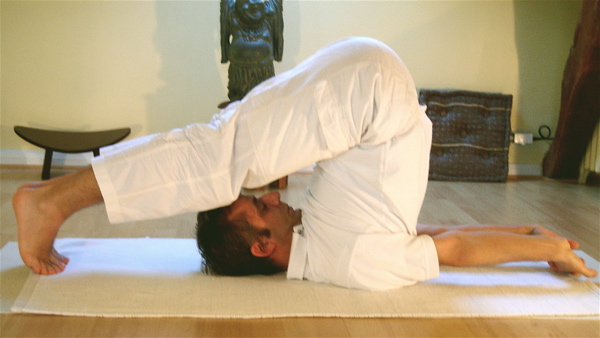
Halasana — Plough Pose — is a calming inversion where the legs fold overhead until the toes reach the floor behind the head, tracing the shape of an old farmer's plough. It stretches the whole back body and quiets the mind, and usually follows Shoulderstand.
Name meaning: From hala meaning "plough" and āsana meaning "posture" — the "plough posture", the folded body tracing the shape of an old farmer's plough.
Classification: Asana — an inverted forward-fold; a calming pose usually paired with Shoulderstand.
Tradition & origin: Plough Pose is documented in the 19th-century Sritattvanidhi (from the Mysore Palace, before 1868), where it is called Lāṇgalāsana — also meaning "plough pose". The modern form is closely tied to Shoulderstand and 20th-century teaching. So it has a real 19th-century record rather than a medieval one.
This guide was drafted with the help of AI and reviewed by us. It is for general education only and is not medical or professional advice. It may contain errors. Please practise mindfully, listen to your body, and consult a qualified yoga teacher or doctor for anything specific. Spotted an error? Tell us in the comments below.
How to do it — step by step
- 1Lie on the back (shoulders on a folded blanket) and lift the legs overhead.
- 2Support the back with the hands, elbows shoulder-width.
- 3Slowly lower the toes toward the floor behind the head.
- 4Only go as far as the toes can reach without straining the neck.
- 5If the toes reach, you can release the arms flat on the floor.
- 6Keep the neck long and still — never turn the head.
- 7Roll down slowly, supporting the back, one vertebra at a time.
Breath & hold
Breathe slowly and steadily. Hold 30–60 seconds once you are comfortable; build up gradually.
Benefits
- ✓Stretches the spine, shoulders and back body.
- ✓Calms the nervous system.
- ✓Relieves tired legs and a busy mind.
- ✓Can ease tension in the upper back.
🪔 The traditional / desi way
- Named for the plough (hala) that turns the soil — the body folds over like the curve of that ancient tool.
- Traditionally practised as a partner to Shoulderstand, with a Fish Pose counter afterward to open the throat and chest.
Common mistakes
- ✕Forcing the toes to the floor and straining the neck.
- ✕Turning the head while in the pose.
- ✕Rolling out of it quickly.
Modifications & props
- 🧩Rest the toes on a chair or bolster behind the head.
- 🧩Keep the hands supporting the back throughout.
- 🧩Prefer Legs-up-the-Wall if the neck is sensitive.
Muscles & anatomy
- 💪Stretched: the whole back body — spine, shoulders and the backs of the legs.
- 💪Working: the core and hands support the back; the shoulders bear the load (not the neck).
- 💪The neck must stay long and still with its natural curve preserved by a blanket.
What you may feel
- 🫧Normal: a broad stretch along the spine and back of the body, and a calming, inward quality.
- 🫧Warning sign: neck pressure or pinching — support the feet, use a blanket, and never turn the head.
Variations to grow into
Bring the arms flat on the floor away from the feet once the toes rest down comfortably, for a fuller "plough" shape.
Karnapidasana (Ear-Pressing Pose) with the knees beside the ears, or Supta Konasana with wide legs — only with an established, neck-safe practice.
Using props
- 🧱A folded blanket under the shoulders to protect the neck.
- 🧱A chair or bolster behind the head to support the feet if they do not reach.
Warm-up & counterpose
- Shoulderstand or Legs-up-the-Wall to prepare the inversion.
- Gentle back-body stretches.
- Fish Pose (Matsyasana) to arch the neck and chest the opposite way.
- Resting on the back before sitting up.
Supporting exercises
Why: Builds the inversion base and gives calming effects safely.
How: Rest the legs up a wall or practise supported Shoulderstand for a few minutes.
Why: Prepares the back-body stretch Plough asks for.
How: Fold gently from the hips over straight legs; hold 30 seconds.
Progression path
Enter from a supported Shoulderstand and lower the toes only as far as they reach without neck strain — supporting them on a chair at first — extending the hold as comfort grows.
Who it suits — and who should modify
- ✓Intermediate practitioners, on a folded blanket, usually after Shoulderstand.
- ✓Those wanting a calming inversion and a full back-body stretch (with the toes supported if needed).
- !Absolute caution: neck/cervical injury, uncontrolled high blood pressure, glaucoma.
- !Avoid (traditional guidance): during pregnancy and menstruation.
- !If the toes do not reach the floor, always support them on a chair rather than straining the neck.
When to practise
Calming, so good later in a practice or in the evening; not on a full stomach.
As training allows; short, comfortable holds built up gradually.
Traditional view vs. modern evidence
The body folded like a plough turning the soil; practised as a partner to Shoulderstand with a Fish Pose counter.
Documented in the 19th-century Sritattvanidhi as Lāṇgalāsana; the modern form is 20th-century.
Valued as a calming inversion and full back-body stretch, done with the neck protected.
Thyroid and digestive cure claims are not established.
Evidence at a glance
Plough stretches the back body and can feel calming.
Consistent with the biomechanics of the inverted forward-fold and the relaxation response.
It is safest with the neck protected and the feet supported.
Consistent with adverse-event data on neck-loading inversions (Cramer et al., PLOS ONE 2013).
It cures thyroid or digestive disorders.
A common claim without solid supporting evidence.
Myths vs. reality
✕ Myth: Push the toes to the floor to do it "properly".
✓ Reality: Forcing the toes down strains the neck; supporting the feet on a chair is the safer, smarter option.
✕ Myth: Plough cures thyroid and digestive disease.
✓ Reality: It is a calming stretch; specific cure claims are traditional, not established fact.
⚠️ Cautions
- AVOID with neck injury, high blood pressure, glaucoma, or during menstruation/pregnancy (traditional guidance). If the toes do not reach, support the feet on a chair or props behind you.
Frequently asked questions
My toes will not reach the floor — is that ok?
Yes. Rest them on a chair or bolster behind you. Forcing them down strains the neck — support is smarter than reach.
Neck feels pinched — what now?
Come out slowly and use a folded blanket under the shoulders so the neck keeps its natural curve. Avoid turning the head.
Key takeaways
- ⭐A calming inversion and full back-body stretch, usually paired with Shoulderstand.
- ⭐Protect the neck with a blanket and support the feet on a chair rather than forcing them down.
- ⭐Documented in the 19th-century Sritattvanidhi (Lāṇgalāsana).
- ⭐Avoid with neck, blood-pressure or eye conditions; follow with Fish Pose.
References
- Wikipedia — Halasana (etymology & origins, Sritattvanidhi) · Encyclopaedia, scholarly-sourced
- Cramer et al. 2013, "Adverse Events Associated with Yoga", PLOS ONE · Peer-reviewed systematic review
Sources are provided for further reading; always consult a qualified teacher or clinician for personal guidance.
📝 Your private notes
Saved only on this device — jot down what helped.
💬 Improvements, corrections & suggestions
Found an error or have a better cue? Share it — practitioners help make each guide more accurate.
No comments yet — be the first to help improve this guide.