DAILY YOGA · Hanumanasana
Monkey (Splits)
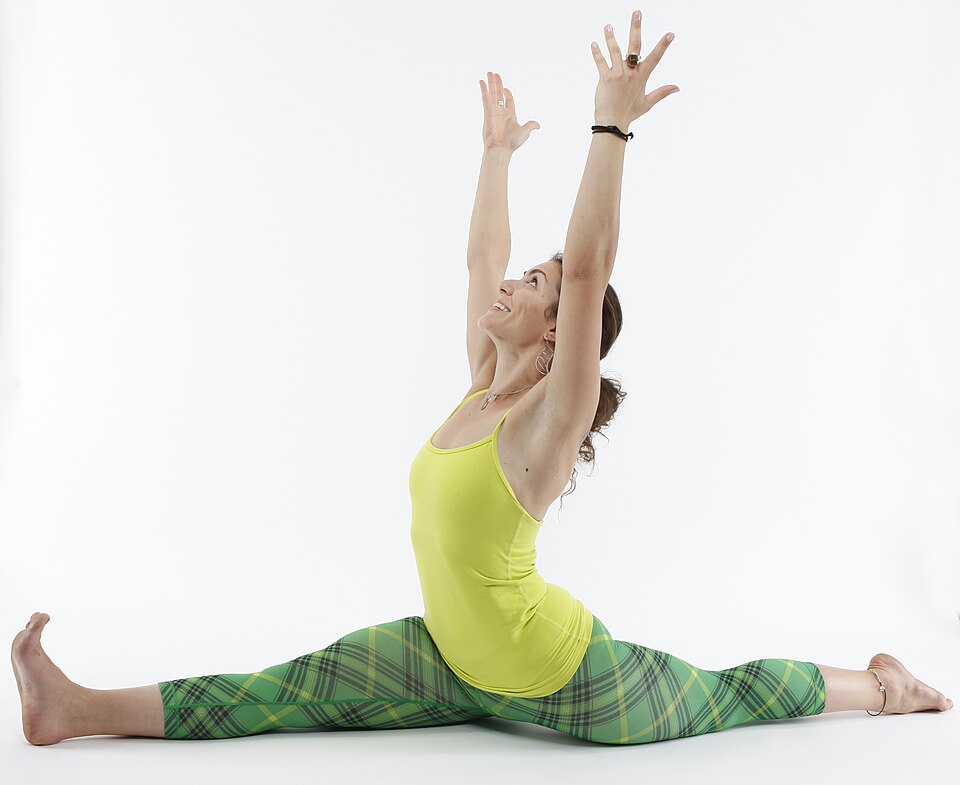
Hanumanasana — the full front-to-back split — is a deep, iconic pose named after Hanuman, the monkey god who leapt across the ocean in a single bound. It stretches the hamstrings and hip flexors intensely and asks for patience, warmth and props on the journey there.
Name meaning: From Hanuman, the divine monkey-hero of Hindu tradition, and āsana meaning "posture" — "Hanuman's posture", commemorating his giant leap to Lanka. It is the yoga version of the front splits.
Classification: Asana — an advanced seated front-splits pose (deep hamstring and hip-flexor stretch).
Tradition & origin: The Splits is a modern pose: it is not described in the medieval hatha texts and appears in the 20th century across modern schools (Pattabhi Jois's Ashtanga, Iyengar's 1966 Light on Yoga, and others). It carries a beloved mythological name but belongs to modern yoga as exercise.
This guide was drafted with the help of AI and reviewed by us. It is for general education only and is not medical or professional advice. It may contain errors. Please practise mindfully, listen to your body, and consult a qualified yoga teacher or doctor for anything specific. Spotted an error? Tell us in the comments below.
How to do it — step by step
- 1From a low lunge, straighten the front leg and flex the foot.
- 2Slowly slide the front heel forward and the back knee back.
- 3Support the hips with hands or blocks on either side.
- 4Keep the hips square to the front and the back thigh pointing down.
- 5Lower only as far as a steady, breathable stretch allows.
- 6Lengthen the spine tall; do not collapse forward.
- 7Come out slowly and switch sides.
Breath & hold
Breathe slowly and steadily; never hold the breath in the stretch. Ease in and out with control.
Benefits
- ✓Deeply stretches the hamstrings and hip flexors.
- ✓Opens the hips and groin.
- ✓Builds patience and body awareness.
- ✓A milestone pose for lower-body flexibility.
🪔 The traditional / desi way
- Named for Hanuman's legendary leap — the split embodies that fearless stretch across a great distance, powered by devotion.
- Traditional wisdom: warm up thoroughly and use blocks under the hands and seat. This is a pose to approach over months, never to force cold.
Common mistakes
- ✕Forcing the hips to the floor before the body is ready.
- ✕Letting the hips fall open (keep them square).
- ✕Bouncing or straining instead of easing in.
Modifications & props
- 🧩Place blocks under the front hip/seat and under the hands.
- 🧩Keep the back knee down and only go partway (half split / Ardha Hanumanasana).
Muscles & anatomy
- 💪Stretched: the front-leg hamstrings and calf, and the back-leg hip flexors (psoas) and quadriceps.
- 💪Working: the core and arms support and level the pelvis; the legs stay active.
- 💪A square, level pelvis protects the hamstrings and lower back.
What you may feel
- 🫧Normal: a strong, spreading stretch through the front-leg hamstring and back-leg hip front.
- 🫧Warning sign: sharp or pinching hamstring/groin pain — ease up onto blocks; never push into pain.
Variations to grow into
Work the half splits (Ardha Hanumanasana) with the back knee down and hands on blocks, gradually easing the front sitting bone toward the floor.
The full splits with the hands in prayer or reaching overhead — only after long, patient preparation, ideally with a teacher.
Using props
- 🧱Blocks under the front hip/seat and under the hands to support the descent.
- 🧱A folded blanket under the back knee for comfort.
Warm-up & counterpose
- Thorough hamstring and hip-flexor warming (lunges, half splits, standing folds).
- Never attempt cold.
- A gentle seated forward fold and a supine figure-4 to settle the hamstrings and hips.
- Child's Pose.
Supporting exercises
Why: Safely lengthens the hamstrings toward the full pose.
How: From a low lunge, shift the hips back over the bent back knee and straighten the front leg; hold 30 seconds each side.
Why: Opens the back-leg hip the full pose needs.
How: From a kneeling lunge, ease the hips forward; 20–30 seconds each side.
Progression path
Spend most of your time in the supported half splits with blocks, easing the front sitting bone lower over weeks and months; approach the full pose only when it feels within comfortable reach — patience prevents hamstring strains.
Who it suits — and who should modify
- ✓Advanced and patient intermediate practitioners with open hamstrings and hips.
- ✓Most people can work the "half splits" (Ardha Hanumanasana) safely with blocks.
- !Modify / avoid: hamstring or groin injury — work only the supported half splits, never forcing.
- !Relative caution: hip, knee or lower-back issues — stay high on blocks and keep the back knee down.
- !Always warm up thoroughly; the full pose is an advanced deep stretch.
When to practise
When the body is thoroughly warm — later in a practice, never cold.
A patient, occasional deep-stretch goal; the half-split can be practised more regularly.
Traditional view vs. modern evidence
Commemorates Hanuman's mighty leap; taught as a symbol of devotion and effort as much as a stretch.
Not in the medieval hatha texts; a 20th-century pose.
Valued as a deep hamstring and hip-flexor opener, approached patiently via the half splits.
No specific medical claims beyond flexibility are established.
Evidence at a glance
Regular, progressive stretching increases hamstring and hip-flexor flexibility over time.
Consistent with flexibility-training evidence; range of motion improves with patient practice.
Forcing the splits risks hamstring/groin strain.
Consistent with sports-medicine evidence on over-stretching cold or forcing end-range.
Myths vs. reality
✕ Myth: Some people just "can't" do the splits.
✓ Reality: Most people can progress with patient, warm practice — but it takes months; blocks and half-splits are the safe path.
✕ Myth: Push harder to get down faster.
✓ Reality: Forcing risks a hamstring or groin strain; support the hips and let depth come gradually.
⚠️ Cautions
- Hamstring, groin or lower-back injury — do not force. Always warm up and use blocks; back off at any sharp sensation.
Frequently asked questions
How long until I can do the full splits?
For most people it takes months of patient, warm practice. Use blocks and enjoy the "half splits" — forcing it risks a hamstring strain.
Should it hurt?
No. A strong stretch is fine; sharp pain is a signal to back off and add support.
Key takeaways
- ⭐The yoga front splits — a deep hamstring and hip-flexor stretch.
- ⭐Work the supported half splits with blocks; never force, and always warm up.
- ⭐A modern pose with a beloved mythological name (Hanuman's leap).
- ⭐Progress over months; forcing risks a hamstring or groin strain.
References
- Wikipedia — Hanumanasana (etymology & origins) · Encyclopaedia, scholarly-sourced
- NCCIH — Yoga: What You Need To Know · Government health body (public domain)
Sources are provided for further reading; always consult a qualified teacher or clinician for personal guidance.
📝 Your private notes
Saved only on this device — jot down what helped.
💬 Improvements, corrections & suggestions
Found an error or have a better cue? Share it — practitioners help make each guide more accurate.
No comments yet — be the first to help improve this guide.