DAILY YOGA · Lolasana
Pendant Pose
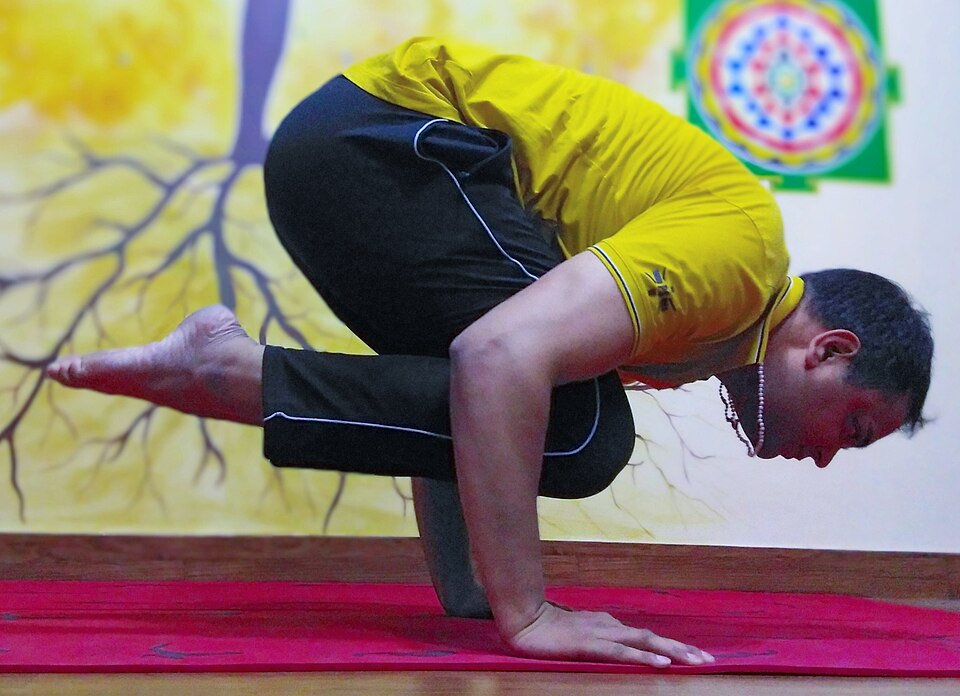
Lolasana — Pendant (Dangling) Pose — is a compact arm balance where, from a kneeling or crossed-leg position, you press the hands down and swing the whole body up, hanging like a pendant between the arms. It builds strong arms, wrists and a powerful core lift.
Name meaning: From lola meaning "dangling", "trembling" or "like a swinging earring/pendant", and āsana — the "pendant posture", the body hanging and swinging lightly from the hands.
Classification: Asana — a seated/lifting arm-balance (a jump-back builder).
Tradition & origin: Pendant Pose is modern: it is unknown in the medieval hatha texts and appears in the 20th century (Iyengar's Light on Yoga). It corresponds to the balancing "jhula" (swing) movement in the 1896 gymnastics manual Vyayama Dipika, which the scholar Norman Sjoman links to Krishnamacharya's Mysore yoga. (Its cousin Kukkutasana IS genuinely medieval.)
This guide was drafted with the help of AI and reviewed by us. It is for general education only and is not medical or professional advice. It may contain errors. Please practise mindfully, listen to your body, and consult a qualified yoga teacher or doctor for anything specific. Spotted an error? Tell us in the comments below.
How to do it — step by step
- 1Kneel and cross the ankles, sitting on or near the heels.
- 2Place the palms flat on the floor beside the hips.
- 3Spread the fingers and press down firmly.
- 4Round the upper back slightly and hug the knees in toward the chest.
- 5Engage the core and lift the crossed legs and hips off the floor.
- 6Let the body dangle, swinging gently if you like.
- 7Lower with control.
Breath & hold
Breathe steadily; hold a few seconds and build up. Do not hold the breath.
Benefits
- ✓Strengthens the arms, wrists and shoulders.
- ✓Builds deep core lift and control.
- ✓Improves balance and body awareness.
- ✓Prepares for jump-backs and other lifts.
🪔 The traditional / desi way
- Lola means "dangling/trembling like an earring" — the body hangs and sways lightly between the hands.
- Traditional cue: press the floor away and round the upper back; the lift is core-driven as much as arm-driven.
Common mistakes
- ✕Relying only on the arms without engaging the core.
- ✕Not rounding the upper back to lift the hips.
Modifications & props
- 🧩Use blocks under the hands for extra height.
- 🧩Lift just the hips, keeping the feet lightly touching, to build strength.
Muscles & anatomy
- 💪Strongly works the wrists, arms, shoulders and deep core.
- 💪The core and hip flexors hug the crossed legs up off the floor.
- 💪A firm downward hand-press and a rounded upper back create the lift.
What you may feel
- 🫧Normal: intense arm, shoulder and core effort as the body lifts and dangles.
- 🫧Warning sign: wrist pain — use blocks under the hands, build strength, or skip.
Variations to grow into
Lift just the hips, keeping the feet lightly touching the floor, to build the strength gradually.
Lift and swing the body back to float into Chaturanga (a vinyasa jump-back) — a strong transition.
Using props
- 🧱Blocks under the hands for extra clearance while building strength.
- 🧱A cushion under the seat if needed.
Warm-up & counterpose
- Wrist mobility and core work to prepare.
- A wrist counter-stretch and a gentle forward fold.
Supporting exercises
Why: Builds the same lifting strength from a folded seat.
How: Cross the legs, press the hands down, and lift the body.
Why: Strengthens the arms and shoulders for the lift.
How: Hold plank and lower slowly, a few times.
Progression path
Start with blocks under the hands, lifting just the hips; build to lifting the whole body with the ankles crossed; use it to develop the vinyasa jump-back.
Who it suits — and who should modify
- ✓Practitioners with strong wrists, arms and core.
- ✓Those building the lift-and-swing for jumping back in vinyasa.
- ✓Anyone developing arm-balance and core strength (knees crossed, not Lotus).
- !Wrist injury or carpal tunnel — build wrist strength first or skip.
- !Shoulder issues — build strength gradually and use blocks.
- !Recent wrist or abdominal surgery — avoid.
When to practise
In the stronger, warmed part of a practice, after wrist preparation.
A couple of times a week; brief lifts, building up.
Traditional view vs. modern evidence
The swinging pendant/earring; the body dangling and lifting from the hands.
Not in the medieval texts; modern (Light on Yoga), from a 19th-c. gymnastics swing.
Valued as a lifting arm-balance and a vinyasa jump-back builder.
Organ-toning claims are not established.
Evidence at a glance
Pendant Pose builds wrist, arm, shoulder and core strength.
Consistent with the biomechanics of a lifting arm-balance.
It has specific organ-toning effects.
A claim without solid supporting evidence.
Myths vs. reality
✕ Myth: It is pure arm strength.
✓ Reality: The core lift and a firm hand-press matter as much as arm strength; technique and leverage count.
✕ Myth: Pendant Pose is an ancient asana.
✓ Reality: It is modern (Light on Yoga); it corresponds to a 19th-century gymnastics swing (jhula). Its cousin Kukkutasana is the genuinely medieval one.
⚠️ Cautions
- Wrist injury — practise cautiously or skip.
Frequently asked questions
I cannot lift off the floor — why?
Press the hands down firmly, round the upper back, and hug the knees in while lifting from the core. Blocks under the hands give clearance while you build strength.
How is it different from Scale Pose?
Tolasana (Scale) lifts from Lotus/cross-legged with legs folded; Lolasana crosses the ankles and hugs the knees in, dangling the body — a great jump-back builder.
Key takeaways
- ⭐A lifting arm-balance — the core lift and hand-press create it; a great jump-back builder.
- ⭐Use blocks under the hands and lift just the hips to start.
- ⭐A modern pose (from a 19th-c. gymnastics swing); Kukkutasana is the medieval cousin.
- ⭐Avoid with wrist issues or recent surgery.
References
- Wikipedia — Kukkutasana (Lolasana / Pendant Pose, origins & Vyayama Dipika) · Encyclopaedia, scholarly-sourced
- NCCIH — Yoga: What You Need To Know · Government health body (public domain)
Sources are provided for further reading; always consult a qualified teacher or clinician for personal guidance.
📝 Your private notes
Saved only on this device — jot down what helped.
💬 Improvements, corrections & suggestions
Found an error or have a better cue? Share it — practitioners help make each guide more accurate.
No comments yet — be the first to help improve this guide.