DAILY YOGA · Makarasana
Crocodile Pose
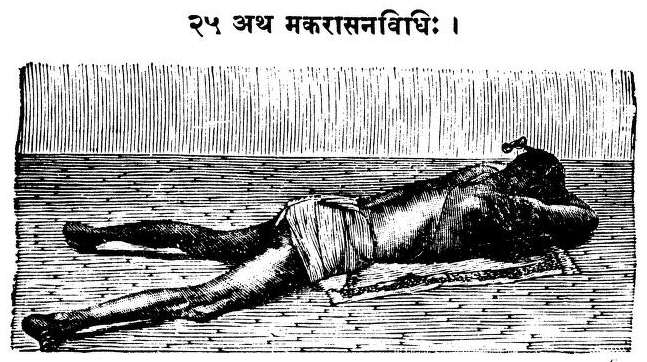
Makarasana — Crocodile Pose — is a restful prone relaxation, lying on the belly with the forehead on stacked arms. Like a crocodile basking still on a riverbank, it releases the lower back and is a wonderful position for relaxed belly-breathing and recovery between backbends.
Name meaning: From makara meaning "crocodile" (or a mythical water-beast, the mount of the sea-god Varuna), and āsana — the "crocodile posture", the body resting prone like a crocodile basking at the water's edge.
Classification: Asana — a prone (face-down) relaxation pose.
Tradition & origin: Crocodile is genuinely medieval: it is described in the 17th-century Gheranda Samhita (2.40) and illustrated in the 1905 Yogasopana Purvacatuska. Interestingly, the old text frames it as energising ("increases bodily heat") while modern practice mostly uses it for relaxation. A real classical pose.
This guide was drafted with the help of AI and reviewed by us. It is for general education only and is not medical or professional advice. It may contain errors. Please practise mindfully, listen to your body, and consult a qualified yoga teacher or doctor for anything specific. Spotted an error? Tell us in the comments below.
How to do it — step by step
- 1Lie on the belly and stack the forearms in front of you.
- 2Rest the forehead on the crossed arms (or turn one cheek down).
- 3Let the legs relax wide, heels falling out, toes turning in or out.
- 4Soften the whole body into the floor.
- 5Feel the belly gently press the floor with each inhale.
- 6Let each exhale release a little more tension.
- 7Rest as long as feels soothing.
Breath & hold
Simply watch the natural belly-breath against the floor. Rest 1–5 minutes.
Benefits
- ✓Deeply relaxes the body and lower back.
- ✓Encourages slow, natural belly-breathing.
- ✓A restful counter-pose after backbends.
- ✓Calms the nervous system.
🪔 The traditional / desi way
- The crocodile (makara) rests utterly still yet fully alert — the pose invites that same effortless, watchful ease.
- Traditional cue: let the belly-breath be the whole practice — feel it press and release against the floor.
Common mistakes
- ✕Tensing the shoulders up by the ears.
- ✕Straining the neck (adjust the arm height so the neck is comfortable).
Modifications & props
- 🧩Place a folded blanket under the chest/forehead for comfort.
- 🧩Turn one cheek to the floor if resting on the arms strains the neck.
Muscles & anatomy
- 💪Releases the whole back body and the shoulders as you rest.
- 💪Encourages the diaphragm and belly to move with the breath.
- 💪No muscular effort in the relaxation form — it is a supported rest.
What you may feel
- 🫧Normal: a settled, heavy, calming feeling and an easy belly-breath.
- 🫧Warning sign: low-back or neck discomfort — widen the legs, turn the head, or pad the forehead.
Variations to grow into
The energising Gheranda/Iyengar form: clasp the hands behind the head and lift the chest and legs like a Locust variation — a strengthening backbend.
Combine with slow, deep diaphragmatic breathing for a longer, meditative prone rest.
Using props
- 🧱A folded blanket under the chest/forehead for comfort.
- 🧱A rolled towel under the ankles if that feels better.
Warm-up & counterpose
- None needed — it is a resting pose.
- Child's Pose or a gentle seated rest; press back up slowly.
Supporting exercises
Why: The prone pose is ideal for training belly-breath.
How: Feel the belly press into the floor on the inhale and soften on the exhale.
Why: Crocodile is a natural rest between such prone backbends.
How: Lift the chest gently, then rest back in Crocodile.
Progression path
Use it mostly for rest and belly-breathing; if you want the classical energising version, add the chest-and-leg lift gradually as a Locust-style backbend.
Who it suits — and who should modify
- ✓Almost everyone — a comfortable, restful prone pose.
- ✓Those wanting a calming rest between belly backbends, or a face-down alternative to Corpse Pose.
- ✓Anyone practising diaphragmatic (belly) breathing — the prone position highlights it.
- !Later pregnancy — lying prone is uncomfortable; choose a side-lying or supported rest instead.
- !Lower-back discomfort when lying flat — widen the legs and let the heels fall out.
- !Neck strain — turn one cheek to the floor or rest the forehead on stacked hands.
When to practise
As a rest between prone backbends, or any time for calming prone relaxation and belly-breathing.
Freely — as often as you like; rest as long as is comfortable.
Traditional view vs. modern evidence
The crocodile basking at the water's edge; in the Gheranda Samhita, a heat-increasing pose.
Genuinely medieval — Gheranda Samhita 2.40 (17th century).
Mostly used as a calming prone relaxation and a great pose for belly-breathing.
Specific curative claims are not established.
Evidence at a glance
Prone rest and diaphragmatic breathing can promote relaxation.
Slow diaphragmatic breathing is well supported for calming the nervous system.
It cures back or organ disease.
A broad claim without solid supporting evidence.
Myths vs. reality
✕ Myth: Crocodile is only a modern relaxation pose.
✓ Reality: It is genuinely medieval (Gheranda Samhita 2.40); the old text even frames it as energising rather than purely restful.
✕ Myth: It "cures" back disease.
✓ Reality: It is soothing for the back and great for belly-breathing, but specific cure claims are not established.
⚠️ Cautions
- Late pregnancy — lying prone is not suitable; choose a side-lying rest instead.
Frequently asked questions
When should I use Crocodile?
As a rest between belly backbends (Cobra, Locust, Bow), or any time you want a calming, supported prone relaxation.
How is it different from Corpse Pose?
Corpse is face-up; Crocodile is face-down, which many find especially soothing for the lower back and for belly-breathing.
Key takeaways
- ⭐A calming prone (face-down) rest — great between backbends and for belly-breathing.
- ⭐Widen the legs and turn or pad the head for comfort.
- ⭐A genuinely medieval pose (Gheranda Samhita 2.40), classically framed as energising.
- ⭐There is also a stronger Locust-style lifting variation.
References
- Wikipedia — Makarasana (Gheranda Samhita 2.40, origins) · Encyclopaedia, scholarly-sourced
- NCCIH — Yoga: What You Need To Know · Government health body (public domain)
Sources are provided for further reading; always consult a qualified teacher or clinician for personal guidance.
📝 Your private notes
Saved only on this device — jot down what helped.
💬 Improvements, corrections & suggestions
Found an error or have a better cue? Share it — practitioners help make each guide more accurate.
No comments yet — be the first to help improve this guide.