DAILY YOGA · Marjariasana
Cat–Cow
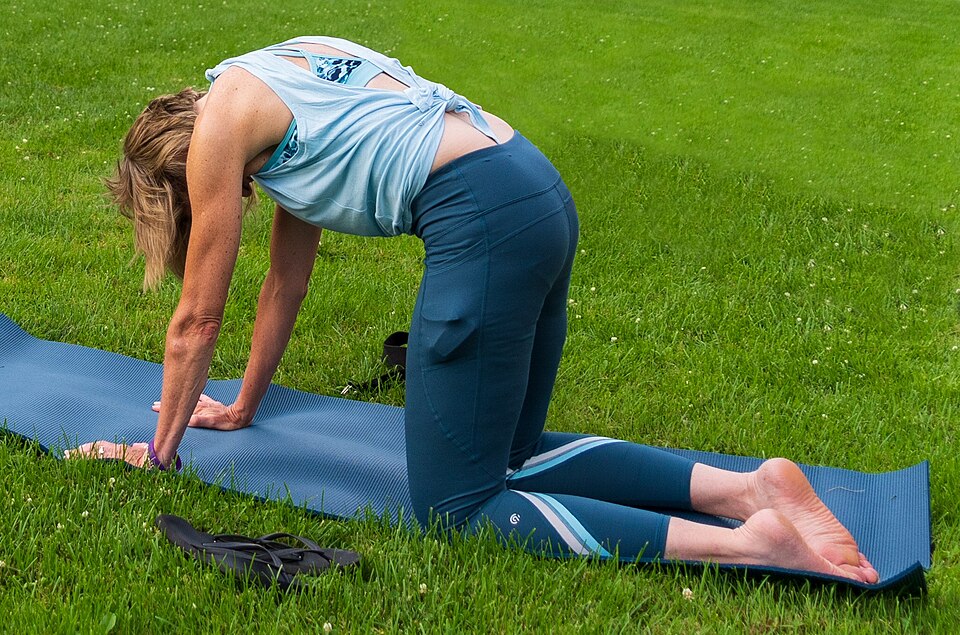
Marjari–Bitilasana — Cat–Cow — is a gentle, flowing movement of the spine on all fours, linking two shapes: the rounded "cat" and the dipped "cow". It is the classic warm-up that wakes up the whole back and syncs movement with breath.
Name meaning: From mārjārī meaning "cat" (the rounded "cat" shape) and bitila / bitilā meaning "cow" (the dipped "cow" shape), with āsana meaning "posture" — the paired "cat" and "cow" postures flowed together.
Classification: Asana (flowing warm-up) — a gentle spinal mobilisation linking two shapes with the breath.
Tradition & origin: Cat–Cow as a named flowing warm-up belongs to modern yoga teaching rather than the medieval hatha texts; the animal images are traditional and universal, but the breath-linked flow is a contemporary way to warm the spine. Present it as a modern mobility movement.
This guide was drafted with the help of AI and reviewed by us. It is for general education only and is not medical or professional advice. It may contain errors. Please practise mindfully, listen to your body, and consult a qualified yoga teacher or doctor for anything specific. Spotted an error? Tell us in the comments below.
How to do it — step by step
- 1Come to hands and knees: wrists under shoulders, knees under hips.
- 2Inhale into Cow: drop the belly, lift the chest and tailbone, gaze up softly.
- 3Exhale into Cat: round the spine, tuck the tailbone, draw the navel up.
- 4Let the head follow the spine naturally in each phase.
- 5Move slowly, one shape per breath.
- 6Continue for 6–10 smooth rounds.
Breath & hold
One movement per breath: inhale for Cow, exhale for Cat. Let the breath lead the spine, not the other way around.
Benefits
- ✓Warms up and mobilises the whole spine.
- ✓Relieves back and neck stiffness.
- ✓Coordinates breath with movement.
- ✓Gently massages the belly and can aid digestion.
🪔 The traditional / desi way
- A favourite opening movement in Indian classes — teachers call it "waking the spine" before any stronger practice.
- The cat (marjari) arching its back and the cow (bitila) dipping are everyday images that make the movement easy for beginners to feel.
Common mistakes
- ✕Rushing so the breath and movement fall out of sync.
- ✕Moving only the lower back instead of the whole spine.
- ✕Sinking heavily into the wrists — spread the fingers and press evenly.
Modifications & props
- 🧩Place a blanket under the knees.
- 🧩Do it seated in a chair, rounding and arching the spine, if the floor is hard on the wrists or knees.
Muscles & anatomy
- 💪Mobilises the whole spine through flexion (cat) and extension (cow).
- 💪Gently engages the abdominals (in cat) and the back extensors (in cow).
- 💪The shoulders and wrists stabilise the all-fours base.
What you may feel
- 🫧Normal: an easy, freeing movement through the back and neck, and breath flowing with the shape.
- 🫧Warning sign: wrist or knee pain, or any spinal pinch — modify the base or reduce the range.
Variations to grow into
Add gentle side-to-side "wagging" or small circles of the spine and hips to explore more directions of movement.
Flow Cat–Cow into Thread-the-Needle or a moving Bird-Dog for added mobility and stability — kept slow and controlled.
Using props
- 🧱A folded blanket under the knees for comfort.
- 🧱A chair for a seated version if the floor is hard on the wrists or knees.
Warm-up & counterpose
- None needed — Cat–Cow is itself a warm-up.
- A neutral all-fours or Child's Pose to settle after the flow.
Supporting exercises
Why: A wrist-free way to mobilise the spine.
How: Sitting tall, round and arch the back with the breath for 6–8 rounds.
Why: Prepares the wrists for the all-fours base.
How: Circle and gently stretch the wrists for 30–60 seconds.
Progression path
Begin with small, slow rounds of pure flexion and extension; over time add side-bending, circles, and transitions into Thread-the-Needle or Bird-Dog.
Who it suits — and who should modify
- ✓Everyone, including complete beginners — one of the safest, gentlest movements in yoga.
- ✓Anyone with a stiff back or neck seeking gentle relief.
- ✓A warm-up before almost any practice.
- !Modify: wrist pain — make fists or come onto the forearms.
- !Modify: knee sensitivity — pad the knees, or do a seated version in a chair.
- !Keep the range comfortable with any acute back injury.
When to practise
Any time; excellent first thing in the morning and at the start of a practice.
Daily and as often as you like; there is no limit on gentle spinal movement.
Traditional view vs. modern evidence
Taught as "waking the spine" before stronger practice; the cat and cow are homely images for the two shapes.
Not a medieval hatha pose; a modern breath-linked warm-up.
Valued as a safe, effective spinal mobiliser and a breath-and-movement primer.
Detox and cure claims are not established.
Evidence at a glance
Gentle spinal mobilisation can ease stiffness and improve comfort of movement.
Consistent with general evidence that gentle mobility work helps back stiffness.
It "detoxes" the organs or cures digestive disease.
The gentle belly movement may feel good, but specific claims are not established.
Myths vs. reality
✕ Myth: Cat–Cow realigns or "cracks" the spine into place.
✓ Reality: It gently mobilises the spine and eases stiffness; it does not realign vertebrae.
✕ Myth: You must move quickly to warm up.
✓ Reality: Slow, breath-led movement warms and mobilises the spine more effectively and safely than rushing.
⚠️ Cautions
- Wrist pain — make fists or come onto the forearms. Knee sensitivity — pad the knees with a folded blanket.
Frequently asked questions
Which is cat and which is cow?
Cat is the rounded, exhaling shape (like a scared cat); Cow is the dipped, inhaling shape with the belly dropping and chest lifting.
How many rounds?
Six to ten slow rounds is a lovely warm-up. Let the breath set the pace.
Key takeaways
- ⭐A gentle, breath-led spinal warm-up — safe for almost everyone.
- ⭐Inhale to Cow (dip), exhale to Cat (round); let the breath lead.
- ⭐A modern mobility movement, not a classical asana.
- ⭐Pad the knees or use a chair to modify for wrists and knees.
References
- NCCIH — Yoga: What You Need To Know · Government health body (public domain)
- Wikipedia — Bitilasana (Cow Pose) · Encyclopaedia, scholarly-sourced
Sources are provided for further reading; always consult a qualified teacher or clinician for personal guidance.
📝 Your private notes
Saved only on this device — jot down what helped.
💬 Improvements, corrections & suggestions
Found an error or have a better cue? Share it — practitioners help make each guide more accurate.
No comments yet — be the first to help improve this guide.