DAILY YOGA · Niralamba Sarvangasana
Unsupported Shoulderstand
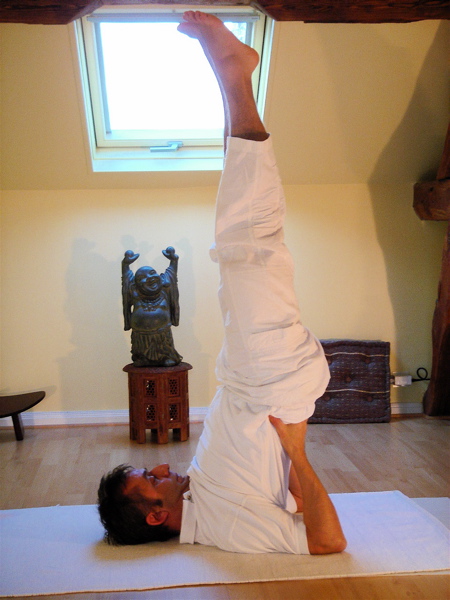
Niralamba Sarvangasana — Unsupported Shoulderstand — is an advanced Shoulderstand held without the hands supporting the back, the arms instead resting down or reaching overhead. It demands significant core and back strength to keep the body vertical, and, like all Shoulderstand-family poses, careful attention to the neck.
Name meaning: From nirālamba meaning "without support/unsupported", sarvāṅga meaning "all limbs" (the whole body), and āsana — the "unsupported all-limbs posture", Shoulderstand held without the hands bracing the back.
Classification: Asana — an advanced inverted core strengthener (a hands-free Shoulderstand).
Tradition & origin: Unsupported Shoulderstand is modern: the held Shoulderstand (Sarvangasana) itself is a 20th-century pose, and this hands-free variation belongs firmly to modern postural yoga. Present it as modern.
This guide was drafted with the help of AI and reviewed by us. It is for general education only and is not medical or professional advice. It may contain errors. Please practise mindfully, listen to your body, and consult a qualified yoga teacher or doctor for anything specific. Spotted an error? Tell us in the comments below.
How to do it — step by step
- 1Establish a steady, supported Shoulderstand on a folded blanket.
- 2Find vertical alignment: hips over shoulders, legs reaching up.
- 3Slowly release the hands from the back, engaging the core to stay lifted.
- 4Rest the arms on the floor alongside the body (or reach them overhead).
- 5Keep the legs reaching strongly up and the neck long and still.
- 6Breathe evenly; do not turn the head.
- 7Return the hands to the back and lower with control.
Breath & hold
Breathe steadily; hold briefly and build up. Never strain the neck.
Benefits
- ✓Strongly strengthens the core and back.
- ✓Calming inversion.
- ✓Builds balance and body control.
- ✓Deepens Shoulderstand practice.
🪔 The traditional / desi way
- Niralamba = without support — the "queen of asanas" held by strength alone, no hands bracing the back.
- Traditional wisdom: master supported Shoulderstand first; the unsupported version is a strength milestone, always with the neck protected.
Common mistakes
- ✕Releasing the hands before the core can hold the lift.
- ✕Turning the head.
- ✕Letting the body sag out of vertical.
Modifications & props
- 🧩Keep the hands supporting the back (regular Salamba Sarvangasana).
- 🧩Release the hands only briefly to build strength.
Muscles & anatomy
- 💪Strongly works the core and back to hold the body vertical without hand support.
- 💪The shoulders and upper back bear the weight (never the neck).
- 💪The legs reach strongly upward.
What you may feel
- 🫧Normal: strong core-and-back effort holding the lift, calm and steady.
- 🫧Warning sign: any neck pressure, or the body sagging — return the hands to the back and lower.
Variations to grow into
Release the hands from the back only briefly, returning them as needed, to build the strength.
Reach the arms overhead along the floor while staying vertical — a greater core challenge.
Using props
- 🧱A folded blanket under the shoulders to protect the neck.
- 🧱Keep the hands supporting the back (regular Shoulderstand) until the core is ready.
Warm-up & counterpose
- A comfortable supported Shoulderstand and core activation.
- A gentle Fish or reclined rest to release the neck.
Supporting exercises
Why: The essential base; must be effortless first.
How: Hold a steady, aligned Shoulderstand with the hands on the back.
Why: Builds the core to hold the lift hands-free.
How: Hold Boat and do slow dead-bug drills.
Progression path
Make supported Shoulderstand effortless; release the hands briefly and build up, always with a blanket under the shoulders and the neck protected.
Who it suits — and who should modify
- ✓Advanced practitioners with an effortless, steady supported Shoulderstand.
- ✓Those with strong core and back and a healthy neck.
- ✓People building toward a hands-free inversion, releasing the hands only briefly at first.
- !Neck/cervical injury, high blood pressure, glaucoma, pregnancy or menstruation — avoid (traditional inversion guidance).
- !Anyone without an effortless supported Shoulderstand — not yet.
- !Always use a blanket under the shoulders and never turn the head.
When to practise
Late in a practice, within a Shoulderstand sequence, well warmed.
Occasionally, for experienced practitioners; brief holds, building up.
Traditional view vs. modern evidence
The "queen of asanas" held by strength alone, no hands bracing the back.
Not in the medieval texts; a modern variation of the 20th-century Shoulderstand.
Valued as an advanced core-and-back strengthener and calming inversion.
Detox/anti-ageing claims are not established.
Evidence at a glance
The pose strongly strengthens the core and back and can feel calming.
Consistent with the biomechanics of a hands-free inversion.
It detoxifies or reverses ageing.
Popular inversion claims without solid supporting evidence.
Myths vs. reality
✕ Myth: Inversions detoxify or reverse ageing.
✓ Reality: Being inverted can feel refreshing, but such claims are not established; the value here is core strength and calm.
✕ Myth: It is safe to push through neck pressure.
✓ Reality: Never — the neck is vulnerable; keep the weight on the shoulders and come down at any pressure.
⚠️ Cautions
- AVOID with neck injury, high blood pressure, glaucoma, or during menstruation/pregnancy. Advanced; blanket under the shoulders and a teacher recommended.
Frequently asked questions
Why release the hands?
It turns Shoulderstand into a demanding core-and-back strengthener. Only do it once your supported Shoulderstand is effortless and steady.
Is it safe for my neck?
Only with a solid Shoulderstand foundation, a blanket under the shoulders, and no head-turning. Skip it with any neck or blood-pressure issue.
Key takeaways
- ⭐An advanced hands-free Shoulderstand — held by core and back strength.
- ⭐Make supported Shoulderstand effortless first; release the hands only briefly to build up.
- ⭐Keep the weight on the shoulders (blanket underneath); never load or turn the neck.
- ⭐Avoid with neck, blood-pressure or eye issues, pregnancy or menstruation.
References
- Wikipedia — Sarvangasana (Niralamba / unsupported variations) · Encyclopaedia, scholarly-sourced
- NCCIH — Yoga: What You Need To Know · Government health body (public domain)
Sources are provided for further reading; always consult a qualified teacher or clinician for personal guidance.
📝 Your private notes
Saved only on this device — jot down what helped.
💬 Improvements, corrections & suggestions
Found an error or have a better cue? Share it — practitioners help make each guide more accurate.
No comments yet — be the first to help improve this guide.