DAILY YOGA · Parighasana
Gate Pose
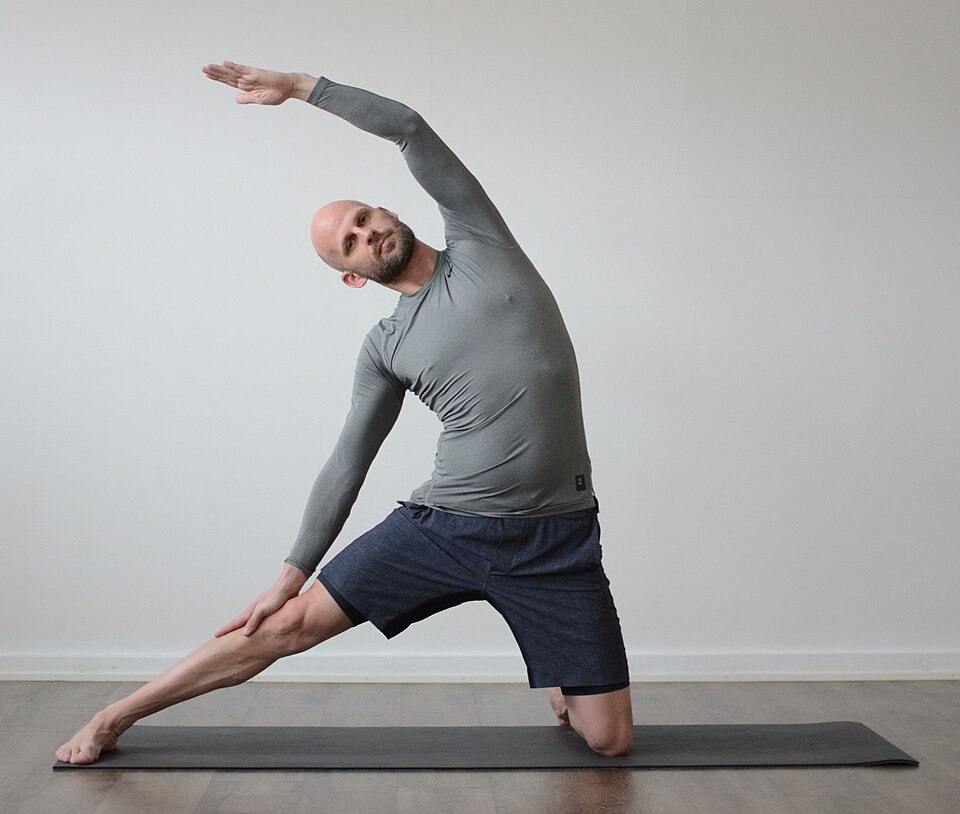
Parighasana — Gate Pose — is a kneeling side stretch that opens the whole side body, from the hip to the fingertips. Named after the beam that bars a gate, it lengthens the waist, opens the ribs for fuller breathing, and gently stretches the hamstring of the extended leg.
Name meaning: From parigha meaning "gate" or "crossbar" (the beam that bars a gate), and āsana — the "gate posture", the extended leg and reaching arm forming a long diagonal like a gate's crossbar.
Classification: Asana — a kneeling side-bend.
Tradition & origin: Gate Pose is modern: it is not known before the 20th century. The scholar Mark Singleton notes it closely resembles a pose in Niels Bukh's 1924 gymnastics, so Krishnamacharya likely drew it from the gymnastics culture of his time. (Note: an unrelated pose called Parighasana appears in the medieval Gheranda Samhita.) Present this side-bend as modern.
This guide was drafted with the help of AI and reviewed by us. It is for general education only and is not medical or professional advice. It may contain errors. Please practise mindfully, listen to your body, and consult a qualified yoga teacher or doctor for anything specific. Spotted an error? Tell us in the comments below.
How to do it — step by step
- 1Kneel with the knees together (pad them if needed).
- 2Extend the right leg out to the side, foot flat, toes pointing forward or slightly out.
- 3Line the right foot up with the left knee.
- 4Inhale and reach both arms out to the sides.
- 5Exhale and side-bend to the right, resting the right hand on the shin.
- 6Sweep the left arm overhead, opening the chest to the ceiling.
- 7Lengthen the top side body; then rise and switch.
Breath & hold
Breathe into the top-side ribs; hold 30–45 seconds each side.
Benefits
- ✓Stretches the side body, waist and intercostal muscles.
- ✓Opens the chest and ribs for deeper breathing.
- ✓Stretches the hamstring of the extended leg.
- ✓Improves lateral spinal mobility.
🪔 The traditional / desi way
- Parigha is the beam that bars a gate — the extended leg and reaching arm form that long, strong line.
- Traditional cue: reach out of the top fingertips rather than collapsing down; open the chest toward the sky.
Common mistakes
- ✕Collapsing the chest toward the floor instead of opening it up.
- ✕Letting the extended-leg knee roll in.
- ✕Crunching the neck.
Modifications & props
- 🧩Place a folded blanket under the kneeling knee.
- 🧩Rest the top hand on the hip instead of reaching overhead.
Muscles & anatomy
- 💪Stretches the whole top side body — waist, ribs, obliques and the side of the chest.
- 💪Opens the intercostal muscles between the ribs, aiding fuller breathing.
- 💪The inner thigh of the extended leg gets a gentle stretch.
What you may feel
- 🫧Normal: a long, satisfying stretch down the entire top side, from hip to fingertips.
- 🫧Warning sign: the chest collapsing forward or knee discomfort — turn the chest up and pad the knee.
Variations to grow into
Reach the top arm further overhead and lay it along the extended leg for a deeper side stretch.
Add a gentle twist of the chest toward the ceiling, or clasp the extended foot with both hands.
Using props
- 🧱A folded blanket under the kneeling knee.
- 🧱A wall to press the extended foot against for balance.
Warm-up & counterpose
- Seated side bends and gentle standing stretches to warm the side body.
- Sit tall and breathe evenly, or a gentle forward fold.
Supporting exercises
Why: Warms the waist and ribs for the side stretch.
How: Reach one arm overhead and lean gently to the side.
Why: A related standing side-body opener.
How: Extend to the side, hand to shin or block.
Progression path
Start with the top hand on the hip and a modest lean; reach the arm overhead and deepen the side-bend as the waist opens, keeping the chest turning up.
Who it suits — and who should modify
- ✓Most practitioners — an accessible side-body opener.
- ✓Those wanting to stretch the waist, ribs and side body.
- ✓Anyone easing tightness along the torso (great for breathing).
- !Knee injury — pad the kneeling knee well, or do the pose seated on a chair.
- !Shoulder issues — rest the top hand on the hip instead of reaching overhead.
- !Balance difficulty — press the extended foot to a wall for stability.
When to practise
Any time; a lovely side-opener in the standing/kneeling part of a practice.
Daily is fine; hold 30–45 seconds each side.
Traditional view vs. modern evidence
The gate's crossbar; a long diagonal opening of the side body.
This side-bend is modern; a different pose bore the name Parighasana in the medieval Gheranda Samhita.
Valued as an accessible side-body and rib-cage opener.
Detox/organ-heal claims are not established.
Evidence at a glance
The pose stretches the side body and intercostals and can aid fuller breathing.
Consistent with anatomy; the target tissues are clearly lengthened.
It detoxifies or heals specific organs.
Claims without solid supporting evidence.
Myths vs. reality
✕ Myth: Gate Pose is an ancient asana.
✓ Reality: This kneeling side-bend is modern (20th century, likely from gymnastics); a different, unrelated Parighasana appears in the medieval Gheranda Samhita.
✕ Myth: It should feel like a forward fold.
✓ Reality: It is a side-bend — turn the chest toward the ceiling rather than collapsing it toward the floor.
⚠️ Cautions
- Knee sensitivity — pad the kneeling knee generously. Shoulder issues — keep the top arm lower.
Frequently asked questions
Where should I feel this?
A long stretch down the entire top side — from the hip, along the waist and ribs, to the top fingertips.
My chest wants to face the floor — how do I fix it?
Roll the top shoulder back and turn the chest toward the ceiling; think of side-bending, not folding forward.
Key takeaways
- ⭐An accessible kneeling side-bend that opens the waist, ribs and breathing.
- ⭐Turn the chest toward the ceiling — side-bend, don't fold forward.
- ⭐Pad the knee; rest the top hand on the hip to modify.
- ⭐A modern pose (a different Parighasana is medieval).
References
- Wikipedia — Parighasana (Gate Pose, modern origins, gymnastics link) · Encyclopaedia, scholarly-sourced
- NCCIH — Yoga: What You Need To Know · Government health body (public domain)
Sources are provided for further reading; always consult a qualified teacher or clinician for personal guidance.
📝 Your private notes
Saved only on this device — jot down what helped.
💬 Improvements, corrections & suggestions
Found an error or have a better cue? Share it — practitioners help make each guide more accurate.
No comments yet — be the first to help improve this guide.