DAILY YOGA · Parsvottanasana
Intense Side Stretch (Pyramid)
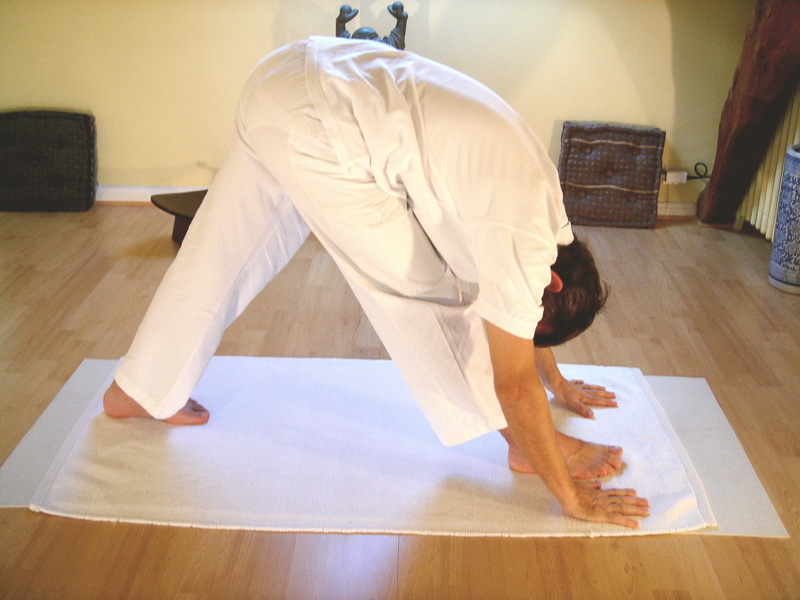
Parsvottanasana — Intense Side Stretch, often called Pyramid Pose — is a standing forward fold over a straight front leg, with the hips squared to the front. It deeply stretches the hamstrings and calf, builds balance, and opens the shoulders (with the hands in reverse prayer).
Name meaning: From pārśva meaning "side", ut meaning "intense", tān meaning "to stretch/extend", and āsana — the "intense side-stretch posture". The English name "Pyramid" comes from the triangular shape of the legs and folded torso.
Classification: Asana — a standing, asymmetric forward bend.
Tradition & origin: Pyramid Pose is modern: it is unknown in the medieval hatha texts and is first described in Krishnamacharya's 1935 Yoga Makaranda, then taught by his pupils Pattabhi Jois and B. K. S. Iyengar. Scholars note its resemblance to 1920s European gymnastics, which likely influenced Krishnamacharya's system.
This guide was drafted with the help of AI and reviewed by us. It is for general education only and is not medical or professional advice. It may contain errors. Please practise mindfully, listen to your body, and consult a qualified yoga teacher or doctor for anything specific. Spotted an error? Tell us in the comments below.
How to do it — step by step
- 1Step one foot back, front foot forward, feet about a leg-length apart.
- 2Turn the back foot in about 45–60° and ground the outer edge.
- 3Square both hips toward the front leg.
- 4Bring the hands into reverse prayer behind the back, or onto blocks.
- 5Inhale and lengthen the spine, lifting the chest.
- 6Exhale and hinge forward over the straight front leg.
- 7Keep both legs strong; gaze toward the shin, then rise with a flat back.
Breath & hold
Breathe steadily; hold 30–45 seconds each side. Lengthen on the inhale, fold on the exhale.
Benefits
- ✓Stretches the hamstrings, calves and hips.
- ✓Improves balance and grounding.
- ✓Opens the shoulders and chest (reverse prayer).
- ✓Strengthens the legs.
🪔 The traditional / desi way
- Parsva = side, uttana = intense stretch — a strong, focused lengthening of the whole back leg and side.
- Traditional cue: square the hips first, then fold with a long spine — the shape is a steady pyramid, wide and grounded at the base.
Common mistakes
- ✕Rounding the back to reach lower.
- ✕Letting the hips fall open instead of squaring them.
- ✕Locking or hyper-extending the front knee.
Modifications & props
- 🧩Rest the hands on blocks either side of the front foot.
- 🧩Keep a micro-bend in the front knee.
Muscles & anatomy
- 💪Stretches the front-leg hamstrings and calf, and the hips and spine as you fold.
- 💪The reverse-prayer arms open the chest, shoulders and wrists.
- 💪The legs and core work to keep the hips square and balanced.
What you may feel
- 🫧Normal: a strong hamstring stretch in the front leg and a chest/shoulder opening from the arms.
- 🫧Warning sign: pulling at the sitting bone (hamstring) — ease off and bend the knee; wrist or shoulder strain — change the arm position.
Variations to grow into
Take reverse-prayer (Paschima Namaskar) arms behind the back for a deeper shoulder and chest opening.
Fold fully so the torso rests along the front thigh, hands framing the foot or reaching the floor, hips staying level and square.
Using props
- 🧱Blocks under the hands either side of the front foot.
- 🧱A strap or opposite-elbow hold instead of reverse prayer.
Warm-up & counterpose
- Sun Salutations and standing forward folds to warm the hamstrings and hips.
- A gentle backbend or standing tall to release the hamstrings and spine.
Supporting exercises
Why: Builds the hamstring length the pose needs.
How: Fold over both legs with soft knees, letting the spine lengthen.
Why: Prepares for reverse-prayer arms.
How: Gentle wrist stretches and chest openers before binding the hands.
Progression path
Start with hands on blocks and a soft front knee; add reverse-prayer arms as the shoulders open; deepen the fold only once you can keep the hips square and the back long.
Who it suits — and who should modify
- ✓Most practitioners with reasonable hamstring flexibility and balance.
- ✓Those wanting a deep, focused hamstring stretch for one leg at a time.
- ✓Anyone working on standing forward-fold alignment and squareness of the hips.
- !Hamstring or lower-back injury — keep a generous bend in the front knee and fold less.
- !Shoulder injury — skip reverse prayer; hold opposite elbows or use blocks.
- !Balance difficulty — widen the stance slightly and use blocks under the hands.
When to practise
In the standing sequence of a practice, once the legs are warm.
A few times a week; hold 30–45 seconds each side.
Traditional view vs. modern evidence
An intense side-stretch; a focused fold over one leg with the hands in humble reverse prayer.
Not in the medieval texts; first described in the 1930s (Yoga Makaranda).
A deep single-leg hamstring stretch and chest/shoulder opener.
Detox claims are not established.
Evidence at a glance
Pyramid stretches the hamstrings and opens the shoulders.
Consistent with anatomy; the target tissues are clearly lengthened.
It "detoxifies" the abdominal organs.
A common forward-fold claim without solid supporting evidence.
Myths vs. reality
✕ Myth: You must keep the front leg perfectly straight.
✓ Reality: A soft front knee protects the hamstring and lets the spine stay long; forcing a locked knee risks strain.
✕ Myth: Pyramid is an ancient classical asana.
✓ Reality: It is a modern pose (first described in the 1930s), likely shaped in part by early-20th-century gymnastics.
⚠️ Cautions
- Shoulder injury — keep the hands on blocks instead of reverse prayer. Hamstring or back issues — keep a soft front knee and fold less.
Frequently asked questions
I cannot do reverse prayer — what else?
Hold opposite elbows behind your back, or rest the hands on blocks by the front foot. The leg stretch is the main event.
How is this different from Pyramid?
They are the same pose — Parsvottanasana is the Sanskrit name and Pyramid is the common English name.
Key takeaways
- ⭐A deep single-leg hamstring stretch with a chest-opening reverse-prayer bind.
- ⭐Keep a soft front knee and square, level hips to protect the hamstring and back.
- ⭐Use blocks and hold opposite elbows if reverse prayer is not available yet.
- ⭐A modern pose (1930s), not a medieval one.
References
- Wikipedia — Parsvottanasana (origins, Yoga Makaranda, gymnastics influence) · Encyclopaedia, scholarly-sourced
- NCCIH — Yoga: What You Need To Know · Government health body (public domain)
Sources are provided for further reading; always consult a qualified teacher or clinician for personal guidance.
📝 Your private notes
Saved only on this device — jot down what helped.
💬 Improvements, corrections & suggestions
Found an error or have a better cue? Share it — practitioners help make each guide more accurate.
No comments yet — be the first to help improve this guide.