DAILY YOGA · Purvottanasana
Upward Plank (Reverse Plank)
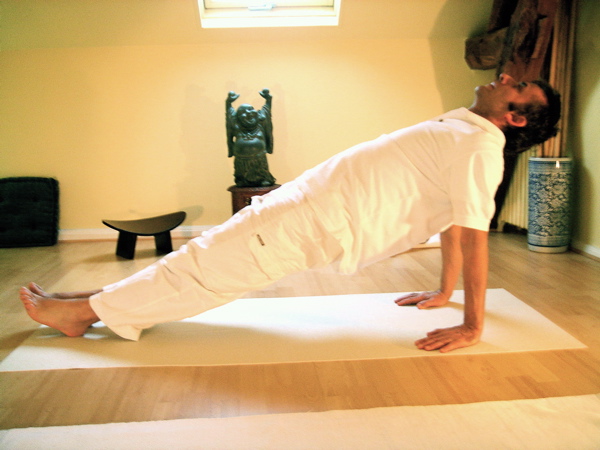
Purvottanasana — Upward Plank (Reverse Plank) — is an energising counter-pose to forward bends, lifting the whole front body toward the sky. It strengthens the arms, back and legs while opening the chest, shoulders and front of the ankles.
Name meaning: From pūrva meaning "east" or "the front of the body", ut meaning "intense", tāna meaning "stretch", and āsana — the "intense stretch of the front body". (The counterpart to Paschimottanasana, the "west/back" stretch.)
Classification: Asana — a reclining front-body-opening strengthener (reverse plank).
Tradition & origin: Upward/Reverse Plank is modern: it belongs to 20th-century yoga as exercise (a variation in the Chaturanga/plank family), not the medieval hatha texts. Present it as modern postural yoga.
This guide was drafted with the help of AI and reviewed by us. It is for general education only and is not medical or professional advice. It may contain errors. Please practise mindfully, listen to your body, and consult a qualified yoga teacher or doctor for anything specific. Spotted an error? Tell us in the comments below.
How to do it — step by step
- 1Sit in Staff Pose with the hands behind the hips, fingers pointing toward the feet.
- 2Bend the knees with feet flat (easier) or keep the legs straight (full pose).
- 3Press into the hands and feet and lift the hips toward the ceiling.
- 4Straighten the arms and reach the chest up and open.
- 5Point the toes toward the floor if the legs are straight.
- 6Let the head follow the spine — only drop it back if the neck is comfortable.
- 7Lower with control and rest.
Breath & hold
Inhale to lift; breathe steadily for 15–30 seconds; exhale to lower. Repeat if you like.
Benefits
- ✓Strengthens the arms, wrists, back and legs.
- ✓Opens the chest, shoulders and front of the ankles.
- ✓A great counter-pose to seated forward bends.
- ✓Energising and posture-improving.
🪔 The traditional / desi way
- Purva = the front/east of the body, uttana = intense stretch — the "front-body stretch", balancing the many forward folds.
- Traditional cue: lift the hips first, then open the chest; keep the shoulders drawing away from the ears.
Common mistakes
- ✕Letting the hips sag so the pose collapses.
- ✕Hunching the shoulders up by the ears.
- ✕Dropping the head back and crunching the neck.
Modifications & props
- 🧩Reverse Tabletop: keep the knees bent and feet flat.
- 🧩Keep the gaze forward instead of dropping the head back.
Muscles & anatomy
- 💪Strengthens the back body — glutes, hamstrings, back and shoulders.
- 💪Opens the chest, shoulders and front of the ankles.
- 💪The wrists and arms work to support the lift.
What you may feel
- 🫧Normal: a strong front-body opening and back-body engagement, chest lifting.
- 🫧Warning sign: wrist or neck strain, or low-back crunching — bend the knees, keep the gaze forward, and lift from the glutes.
Variations to grow into
Reverse Tabletop: keep the knees bent and feet flat for a gentler version.
Straight legs with pointed toes and the head gently back (full Upward Plank), hips lifting high.
Using props
- 🧱Blocks under the hands if the wrists are sensitive.
- 🧱Keep the gaze forward if dropping the head back strains the neck.
Warm-up & counterpose
- Gentle wrist mobility and a few Bridge lifts.
- A gentle forward fold to release the front body.
Supporting exercises
Why: Builds the glute and back strength to lift the hips.
How: Lift the hips from a bent-knee supine position.
Why: The gentler version; builds the shape.
How: Knees bent, feet flat, lift the hips level.
Progression path
Start with Reverse Tabletop; progress to straight legs and a higher hip-lift as the shoulders and wrists strengthen.
Who it suits — and who should modify
- ✓Most practitioners — accessible in the bent-knee (Reverse Tabletop) form.
- ✓Those wanting to open the chest and strengthen the back body and wrists.
- ✓A good counter after forward bends.
- !Wrist injury or carpal tunnel — use Reverse Tabletop (knees bent) or turn the fingers out.
- !Shoulder issues — keep the lift modest; do not drop the head back if it strains the neck.
- !Lower-back discomfort — lift the hips from the glutes and core, not by crunching.
When to practise
After forward bends, to balance the body, or in the strengthening part of a practice.
A few times a week; hold 15–30 seconds.
Traditional view vs. modern evidence
An intense stretch of the front ("east") body; the counterpart to the seated forward fold.
Not in the medieval texts; a modern pose.
Valued as a front-body opener and back-body strengthener, and a forward-fold counter.
No special claims beyond strength and stretch.
Evidence at a glance
The pose strengthens the back body and opens the chest.
Consistent with exercise science for reverse-plank holds.
It has specific organ-therapeutic effects.
No evidence beyond strength and stretch benefits.
Myths vs. reality
✕ Myth: You must drop the head all the way back.
✓ Reality: Only drop the head if the neck is comfortable; keeping the gaze forward is a fine, safer option.
✕ Myth: It is an ancient asana.
✓ Reality: It is a modern pose in the plank family.
⚠️ Cautions
- Wrist or shoulder injury — try Reverse Tabletop (knees bent, feet flat) instead. Neck issues — keep the head neutral.
Frequently asked questions
Straight legs or bent knees?
Bent knees (Reverse Tabletop) is the gentler version; straight legs with pointed toes is the full Upward Plank. Choose what lets you lift the hips fully.
Why do this after forward bends?
It stretches the front body in the opposite direction, balancing all the folding and opening the chest.
Key takeaways
- ⭐A front-body opener and back-body strengthener — a great forward-fold counter.
- ⭐Use Reverse Tabletop (knees bent) to modify; blocks help sensitive wrists.
- ⭐Keep the gaze forward if dropping the head back strains the neck.
- ⭐A modern pose (plank family).
References
- Wikipedia — Chaturanga Dandasana (Purvottanasana / Reverse Plank) · Encyclopaedia, scholarly-sourced
- NCCIH — Yoga: What You Need To Know · Government health body (public domain)
Sources are provided for further reading; always consult a qualified teacher or clinician for personal guidance.
📝 Your private notes
Saved only on this device — jot down what helped.
💬 Improvements, corrections & suggestions
Found an error or have a better cue? Share it — practitioners help make each guide more accurate.
No comments yet — be the first to help improve this guide.