DAILY YOGA · Samasthiti
Equal Standing
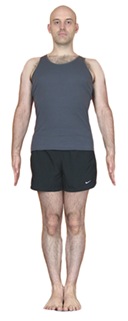
Samasthiti — Equal Standing — is the alert, balanced standing posture from which Sun Salutations begin. Often used interchangeably with Tadasana, it emphasises the quality of "equal, steady standing": weight even, body aligned, mind attentive and ready.
Name meaning: From sama meaning "equal/even", sthiti meaning "standing/steadiness", and (implicitly) āsana — "equal, steady standing", an attentive, evenly-balanced standing position. Nearly identical to Tadasana (Mountain).
Classification: Asana — a foundational standing pose (the attentive "ready" position).
Tradition & origin: Equal Standing is modern: like Tadasana it belongs to modern postural yoga (it marks the start and returns of the Sun Salutation), not the medieval hatha texts. Present it as modern.
This guide was drafted with the help of AI and reviewed by us. It is for general education only and is not medical or professional advice. It may contain errors. Please practise mindfully, listen to your body, and consult a qualified yoga teacher or doctor for anything specific. Spotted an error? Tell us in the comments below.
How to do it — step by step
- 1Stand with the feet together (or hip-width), weight even on both feet.
- 2Ground down through all four corners of each foot.
- 3Firm the legs gently and lengthen the tailbone down.
- 4Stack the ribs over the hips, shoulders over hips.
- 5Bring the palms together at the heart (Anjali mudra), or rest arms by the sides.
- 6Lift through the crown and soften the gaze.
- 7Breathe evenly, standing steady and attentive.
Breath & hold
Breathe evenly; stand for a few breaths, gathering attention before you move.
Benefits
- ✓Cultivates balance, alignment and steadiness.
- ✓Centres the mind before movement.
- ✓Improves posture and body awareness.
- ✓The attentive "ready" state for a flowing practice.
🪔 The traditional / desi way
- Sama = equal/even, sthiti = standing/steadiness — the posture of balanced readiness, the still point before the Sun Salutation begins.
- Traditional cue: it is as much a state of mind as a shape — stand equal, steady and present, palms at the heart.
Common mistakes
- ✕Locking the knees or gripping the toes.
- ✕Letting the mind wander — the pose is about attentive stillness.
Modifications & props
- 🧩Stand with the feet hip-width for more stability.
Muscles & anatomy
- 💪The whole body is evenly toned — legs firm, spine tall, shoulders relaxed.
- 💪Subtle balancing muscles of the feet and ankles engage.
- 💪It cultivates attentive, upright posture more than a stretch.
What you may feel
- 🫧Normal: a grounded, tall, alert and even feeling.
- 🫧Warning sign: light-headedness — soften the knees and breathe.
Variations to grow into
Bring the palms together at the heart (Anjali Mudra) to begin a Sun Salutation with a moment of stillness.
Close the eyes to feel the balance from within (a subtle proprioception challenge).
Using props
- 🧱None needed; stand with the feet hip-width if balance is an issue.
Warm-up & counterpose
- None needed — it is itself a settling start.
- None needed; simply move into the next pose.
Supporting exercises
Why: The near-identical alignment focus.
How: Stand tall, body lengthening from feet to crown.
Why: Steady the standing base.
How: Stand tall, eyes closed, feeling subtle sway settle.
Progression path
Use it to set alignment and attention at the start of practice; add Anjali Mudra and eyes-closed steadiness to deepen the focus.
Who it suits — and who should modify
- ✓Everyone — the simplest, most accessible standing pose.
- ✓Those learning alignment and an attentive, ready quality.
- ✓Anyone starting or punctuating a Sun Salutation.
- !Light-headedness standing still — soften the knees slightly.
- !Balance difficulty — stand with the feet hip-width for stability.
- !Generally very safe for all.
When to practise
To begin and to punctuate a practice, especially Sun Salutations.
Freely, daily — it is a foundational position.
Traditional view vs. modern evidence
Equal, even standing; an attentive, ready stillness.
Not in the medieval texts; a modern foundational position.
Valued as the alignment-and-attention start of practice, especially Sun Salutations.
No special claims beyond posture and steadiness.
Evidence at a glance
The pose cultivates upright posture and attentive steadiness.
Consistent with basic postural and balance principles.
It has specific therapeutic effects.
No evidence beyond posture and steadiness.
Myths vs. reality
✕ Myth: It is too simple to matter.
✓ Reality: It sets alignment and attention for everything that follows — a steady start makes a steady practice.
✕ Myth: It is an ancient asana.
✓ Reality: Like Tadasana, it is a modern foundational standing position.
⚠️ Cautions
- Very safe. If standing still makes you light-headed, soften the knees slightly.
Frequently asked questions
Samasthiti or Tadasana?
They are nearly the same. Tadasana ("mountain") stresses the aligned shape; Samasthiti ("equal standing") stresses the attentive, ready quality — often with palms at the heart to start a Sun Salutation.
Why does such a simple pose matter?
It sets your alignment and attention for everything that follows — a steady start makes for a steady practice.
Key takeaways
- ⭐An attentive, evenly-balanced standing position — nearly identical to Mountain Pose.
- ⭐Sets alignment and attention for the whole practice.
- ⭐Marks the start and returns of the Sun Salutation (often with palms at the heart).
- ⭐A modern foundational pose; soften the knees if light-headed.
References
- Wikipedia — Tadasana (Samasthiti / Equal Standing) · Encyclopaedia, scholarly-sourced
- NCCIH — Yoga: What You Need To Know · Government health body (public domain)
Sources are provided for further reading; always consult a qualified teacher or clinician for personal guidance.
📝 Your private notes
Saved only on this device — jot down what helped.
💬 Improvements, corrections & suggestions
Found an error or have a better cue? Share it — practitioners help make each guide more accurate.
No comments yet — be the first to help improve this guide.