DAILY YOGA · Sasangasana
Rabbit Pose
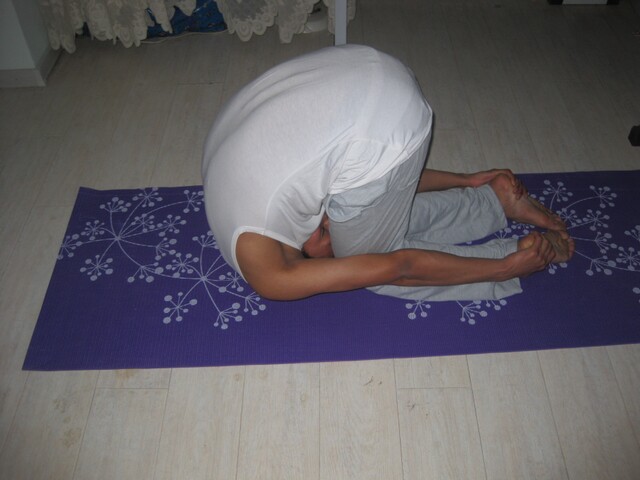
Sasangasana — Rabbit Pose — is a rounded forward stretch from a kneeling position, drawing the crown lightly toward the knees and rounding the spine like a curled rabbit. It stretches the back, shoulders and neck — gently, and always with great care for the neck.
Name meaning: From śaśāṅga (śaśa, "hare/rabbit") and āsana — the "rabbit posture", the rounded, tucked body resembling a hare. (Bikram Yoga popularised it as "Rabbit Pose".)
Classification: Asana — a kneeling deep forward-flexion of the spine.
Tradition & origin: Rabbit Pose is modern: it is not in the medieval hatha texts and is best known as one of the set poses in 20th-century Bikram Yoga. Present it as modern postural yoga.
This guide was drafted with the help of AI and reviewed by us. It is for general education only and is not medical or professional advice. It may contain errors. Please practise mindfully, listen to your body, and consult a qualified yoga teacher or doctor for anything specific. Spotted an error? Tell us in the comments below.
How to do it — step by step
- 1Kneel in Child's Pose position, sitting on the heels.
- 2Hold the heels with the hands.
- 3Tuck the chin toward the chest and round the spine.
- 4Place the crown of the head lightly on the floor near the knees.
- 5Keep MOST of the weight in the hands and hips — very little on the head.
- 6Lift the hips slightly to round the upper back.
- 7Come up slowly, rolling the spine up.
Breath & hold
Breathe smoothly; hold only 15–30 seconds. Come out slowly.
Benefits
- ✓Stretches the spine, upper back and shoulders.
- ✓Releases tension along the back of the neck (gently).
- ✓Can feel soothing for the mind.
- ✓Complements backbends with a rounded counter-stretch.
🪔 The traditional / desi way
- The curled rabbit (sasanga) — a compact, rounded shape that lengthens the whole back of the body.
- Traditional caution is emphatic: keep the weight in the hands, never load the neck — this is a gentle stretch, not a pressure pose.
Common mistakes
- ✕Putting too much weight on the head/neck.
- ✕Forcing the crown to the floor.
- ✕Coming up quickly.
Modifications & props
- 🧩Keep the crown hovering just above the floor, weight fully in the hands.
- 🧩Practise Child's Pose instead if the neck feels at all vulnerable.
Muscles & anatomy
- 💪Stretches the whole back of the spine, the neck extensors and the shoulders.
- 💪The hands and hips carry the weight to protect the neck.
- 💪A deep flexion — the opposite of a backbend.
What you may feel
- 🫧Normal: a broad stretch along the spine and upper back, weight held in the hands.
- 🫧Warning sign: any pressure or pain in the neck — lift the crown, put more weight in the hands, or come out to Child's Pose.
Variations to grow into
Keep the crown hovering just above the floor with almost all the weight in the hands for a safer version.
Lightly rest the crown and round more deeply — only with a healthy neck and great control.
Using props
- 🧱A folded blanket under the knees.
- 🧱Keep the hands firmly on the heels to unload the neck.
Warm-up & counterpose
- Cat–Cow and gentle neck stretches to warm the spine.
- A gentle backbend or lying flat to release the spine.
Supporting exercises
Why: A safe, gentle alternative and preparation.
How: Fold forward from kneeling, forehead resting down.
Why: Warms spinal flexion and extension safely.
How: Alternate rounding and arching the spine with the breath.
Progression path
Start with the crown hovering and weight fully in the hands; only lightly rest the crown once the neck is comfortable and controlled — never grind the head down.
Who it suits — and who should modify
- ✓Practitioners with a healthy neck, wanting a deep spinal-flexion stretch.
- ✓Those comfortable kneeling and taking weight mostly in the hands.
- ✓Anyone easing tension along the back of the spine — with great care.
- !Neck or cervical injury — this pose loads the neck; keep the weight in the hands, or skip it entirely for Child's Pose.
- !High blood pressure, glaucoma or dizziness — avoid the head-down flexion.
- !Disc issues — deep spinal flexion may aggravate; choose gentler options.
When to practise
Occasionally, in the seated part of a practice, with a warm spine.
Sparingly and briefly; the neck should never be strained.
Traditional view vs. modern evidence
The tucked hare; a rounding of the spine to stretch the back body.
Not in the medieval texts; a modern pose (Bikram Yoga).
Used as a deep spinal-flexion stretch — with real neck caution.
Spine-realignment and cure claims are not established.
Evidence at a glance
The pose stretches the spine and upper back.
Plausible via the flexion stretch; robust pose-specific evidence is limited and neck load is a real concern.
It cures thyroid or spinal disease.
Claims without solid supporting evidence.
Myths vs. reality
✕ Myth: Rabbit Pose "realigns the spine" or cures neck problems.
✓ Reality: It is a deep spinal-flexion stretch; it does not realign the spine and can actually strain the neck if forced.
✕ Myth: It is an ancient asana.
✓ Reality: It is a modern pose, popularised by 20th-century Bikram Yoga.
⚠️ Cautions
- Neck injury, high blood pressure, glaucoma, or disc issues — avoid, or keep the crown off the floor entirely. The neck is vulnerable here.
Frequently asked questions
Is Rabbit Pose safe for the neck?
Only with great care — keep almost all the weight in the hands and hips, and never grind the head down. If in doubt, skip it and do Child's Pose.
Where should I feel it?
A gentle stretch along the whole spine and the back of the shoulders — never sharp pressure in the neck.
Key takeaways
- ⭐A deep spinal-flexion stretch — keep almost all the weight in the hands.
- ⭐Real neck caution: never grind the head down; skip it for Child's Pose if unsure.
- ⭐A modern pose (Bikram Yoga), not a medieval one.
- ⭐Avoid with neck, disc, blood-pressure or eye issues.
References
- Wikipedia — Balasana (Sasangasana / Rabbit Pose, Bikram) · Encyclopaedia, scholarly-sourced
- NCCIH — Yoga: What You Need To Know · Government health body (public domain)
Sources are provided for further reading; always consult a qualified teacher or clinician for personal guidance.
📝 Your private notes
Saved only on this device — jot down what helped.
💬 Improvements, corrections & suggestions
Found an error or have a better cue? Share it — practitioners help make each guide more accurate.
No comments yet — be the first to help improve this guide.