DAILY YOGA · Setu Bandhasana
Bridge Pose
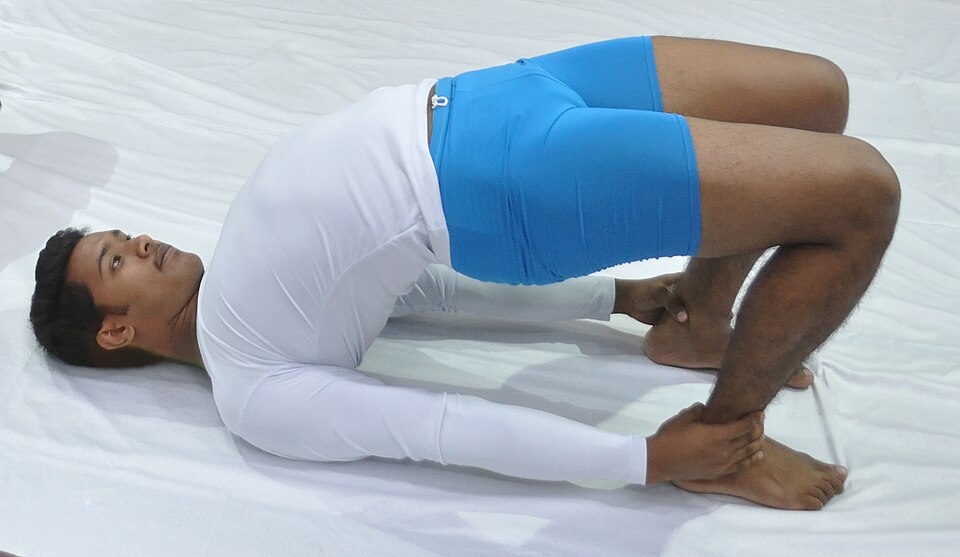
Setu Bandha Sarvangasana — Bridge Pose — is an accessible backbend that strengthens the back, opens the chest, and gently energises the body. The name means "bridge formation", and the shape looks just like an arching bridge lifting from the earth.
Name meaning: From setu meaning "bridge", bandha meaning "lock" or "formation", and (in the full name) sarvāṅga meaning "all limbs" with āsana, "posture" — the "bridge-formation posture".
Classification: Asana — a supine backbend (and, in its full shoulder-supported form, a mild inversion).
Tradition & origin: The pose appears as "Kāmapīṭhāsana" in the 19th-century Sritattvanidhi (written before 1868), giving it a real, if not medieval, textual record; the widely practised modern form was set out by 20th-century teachers such as Iyengar. Present it as a pose with a documented 19th-century lineage rather than an ancient hatha asana.
This guide was drafted with the help of AI and reviewed by us. It is for general education only and is not medical or professional advice. It may contain errors. Please practise mindfully, listen to your body, and consult a qualified yoga teacher or doctor for anything specific. Spotted an error? Tell us in the comments below.
How to do it — step by step
- 1Lie on the back, knees bent, feet flat and hip-width apart.
- 2Bring the heels close enough to graze with the fingertips.
- 3Press the feet and arms down and lift the hips on an inhale.
- 4Roll the shoulders under and clasp the hands beneath the back (optional).
- 5Keep the knees tracking forward, not splaying out.
- 6Lift the chest toward the chin without crunching the neck.
- 7Lower slowly, one vertebra at a time, on an exhale.
Breath & hold
Inhale to lift, breathe steadily for 30–45 seconds, exhale to release. Repeat 2–3 times.
Benefits
- ✓Strengthens the back, glutes and hamstrings.
- ✓Opens the chest, shoulders and front of the hips.
- ✓Counters slouching and long hours of sitting.
- ✓Can feel gently energising and mood-lifting.
🪔 The traditional / desi way
- A bridge (setu) connects two shores — traditionally the pose is seen as linking the grounded body with lifted, open-hearted energy.
- A gentle preparatory backbend in classical sequences before deeper shapes like Wheel.
Common mistakes
- ✕Letting the knees splay outward.
- ✕Turning the head while in the pose (protects the neck).
- ✕Pushing the hips so high the lower back pinches.
Modifications & props
- 🧩Place a block under the sacrum for a restful, supported bridge.
- 🧩Keep the arms flat by the sides instead of clasping.
Muscles & anatomy
- 💪Working: the glutes, hamstrings and spinal extensors lift and hold the hips; the legs press down.
- 💪Stretched: the chest, front of the shoulders and hip flexors open.
- 💪Stabilising: the feet and upper arms/shoulders create the base.
What you may feel
- 🫧Normal: effort in the glutes and back, an open feeling across the chest, and length in the front hips.
- 🫧Warning sign: neck strain or lower-back pinching — lower the hips, lengthen, and never turn the head.
Variations to grow into
Clasp the hands beneath the back and roll the shoulders further under, lifting the chest a little higher.
Eka Pada Setu Bandhasana (One-Legged Bridge): extend one leg vertically while keeping the hips level — a strength and stability challenge. (Full Wheel, Urdhva Dhanurasana, is a separate, deeper backbend.)
Using props
- 🧱A block under the sacrum for a restful, fully supported bridge.
- 🧱A folded blanket under the shoulders to protect the neck.
Warm-up & counterpose
- Cat–Cow and gentle knee-to-chest rocks.
- A few glute bridges to activate the back of the legs.
- Hug the knees to the chest to release the lower back.
- A gentle supine twist to neutralise the spine.
Supporting exercises
Why: Builds the glute and hamstring strength the lift needs.
How: Lift and lower the hips slowly 10–12 times, keeping the knees parallel.
Why: Frees the shoulders and chest for a fuller lift.
How: Clasp the hands behind the back and gently lift them; hold 20–30 seconds.
Progression path
Begin with a low lift or the block-supported version, then build height and add the hand clasp; progress to the one-legged variation only once the basic pose feels strong and stable.
Who it suits — and who should modify
- ✓Beginners, as an accessible first backbend.
- ✓Desk workers wanting to open the chest and front hips.
- ✓Those building back and glute strength; also excellent as a supported, restorative pose.
- !Absolute caution: neck injury — do not turn the head; use a supported (block) version or skip.
- !Modify: late pregnancy — practise briefly or choose a supported side-lying alternative.
- !Relative caution: recent back or shoulder injury — keep the lift low or use the block-supported form.
When to practise
Any time once warm; gentle enough for evening practice and, in its supported form, for winding down.
Safe most days; 2–3 lifts, or a few minutes in the supported version.
Traditional view vs. modern evidence
The bridge linking two shores is read as connecting the grounded body with lifted, open-hearted energy; a preparatory backbend before deeper shapes.
Recorded as Kāmapīṭhāsana in the 19th-century Sritattvanidhi; the modern form is 20th-century.
Valued as an accessible backbend for back and glute strength and chest opening, with a useful supported/restorative version.
Specific therapeutic claims beyond strengthening and opening are not established.
Evidence at a glance
Bridge strengthens the glutes, hamstrings and back and opens the chest.
Consistent with the biomechanics of a hip-lift backbend; glute bridging is well established in strength work.
As part of yoga, it can help counter the effects of prolonged sitting.
Plausible and widely taught; direct pose-specific trials are limited.
Myths vs. reality
✕ Myth: Bridge and Wheel are the same pose.
✓ Reality: Bridge keeps the shoulders on the floor and is gentle; Wheel (Urdhva Dhanurasana) presses all the way up onto the hands and feet and is far deeper.
✕ Myth: Lifting the hips as high as possible is best.
✓ Reality: Over-lifting can pinch the lower back; a moderate, well-aligned lift is safer and more effective.
⚠️ Cautions
- Neck injury — do not turn the head; consider a supported version. Late pregnancy — practise with care or choose an alternative.
Frequently asked questions
Bridge or Wheel?
Bridge is the gentle, accessible backbend with shoulders on the floor. Wheel (Urdhva Dhanurasana) is the deep, full backbend pressing up onto hands and feet.
My neck feels strained — why?
Avoid turning the head, and lift the chest toward the chin rather than jamming the chin down. A supported (block) version is gentler.
Key takeaways
- ⭐An accessible backbend that strengthens the back and glutes and opens the chest.
- ⭐Keep the knees parallel, lift moderately, and never turn the head.
- ⭐Documented in the 19th-century Sritattvanidhi; the modern form is 20th-century.
- ⭐Use a block under the sacrum for a restful, supported version.
References
- Wikipedia — Setu Bandha Sarvangasana (etymology & origins, Sritattvanidhi) · Encyclopaedia, scholarly-sourced
- NCCIH — Yoga: What You Need To Know · Government health body (public domain)
Sources are provided for further reading; always consult a qualified teacher or clinician for personal guidance.
📝 Your private notes
Saved only on this device — jot down what helped.
💬 Improvements, corrections & suggestions
Found an error or have a better cue? Share it — practitioners help make each guide more accurate.
No comments yet — be the first to help improve this guide.