DAILY YOGA · Supta Baddha Konasana
Reclined Bound Angle
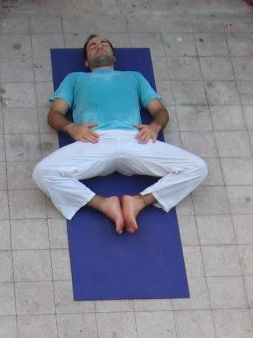
Supta Baddha Konasana — Reclined Bound Angle — is a restorative reclining pose where the soles of the feet meet and the knees fall open as you lie back. It gently opens the hips and chest while inviting deep relaxation, making it a favourite for winding down and for restorative practice.
Name meaning: From supta meaning "reclining/supine", baddha meaning "bound", koṇa meaning "angle", and āsana — the "reclining bound-angle posture". Also called Reclining Cobbler's Pose or Reclining Butterfly.
Classification: Asana — a restorative, reclining hip- and groin-opener.
Tradition & origin: This is the reclining (supta) variant of Baddha Konasana. The upright seated shape is genuinely medieval (Bhadrasana, in the 15th-century Hatha Yoga Pradipika 1.53–54), while this supported reclining, restorative form belongs to modern practice. So the seat is old; the restful reclining version is modern.
This guide was drafted with the help of AI and reviewed by us. It is for general education only and is not medical or professional advice. It may contain errors. Please practise mindfully, listen to your body, and consult a qualified yoga teacher or doctor for anything specific. Spotted an error? Tell us in the comments below.
How to do it — step by step
- 1Sit with the soles of the feet together, knees out (Bound Angle).
- 2Slowly recline onto the back, supporting yourself on the forearms.
- 3Lie all the way down, letting the knees fall open.
- 4Rest the arms out to the sides, palms up.
- 5Place the feet a comfortable distance from the pelvis.
- 6Close the eyes, soften the belly, and breathe slowly.
- 7To exit, use the hands to draw the knees together before rolling to a side.
Breath & hold
Breathe slowly and naturally. Rest here 3–10 minutes, fully supported.
Benefits
- ✓Gently opens the hips, inner thighs and chest.
- ✓Deeply relaxes the nervous system.
- ✓Relieves fatigue and can ease mild stress.
- ✓A soothing restorative and pre-sleep pose.
🪔 The traditional / desi way
- The reclined form of the cobbler's pose — surrendered and open, a posture of complete rest.
- Traditional restorative cue: support everything. With bolsters under the spine and blocks under the knees, the body can let go entirely.
Common mistakes
- ✕Letting the knees strain open with no support.
- ✕Placing the feet too close so the groin over-stretches.
Modifications & props
- 🧩Place a block or cushion under each knee/thigh.
- 🧩Recline over a bolster placed lengthwise along the spine.
- 🧩Move the feet further from the pelvis for a gentler groin stretch.
Muscles & anatomy
- 💪Gently stretches the inner thighs (adductors) and groins as the knees fall open.
- 💪Opens the chest and belly when the torso is supported on a bolster.
- 💪No muscular effort — it is a supported, passive release.
What you may feel
- 🫧Normal: a soft, restful opening across the inner thighs and a calm, settled feeling.
- 🫧Warning sign: strain or pulling at the inner thighs or knees — add support and move the feet further out.
Variations to grow into
Recline over a lengthwise bolster to open the chest more, arms resting wide.
There is no "deeper" goal — the practice is to relax more completely, adding props until the body fully lets go.
Using props
- 🧱A block or cushion under each thigh so the hips can release.
- 🧱A bolster along the spine to prop the torso; an eye pillow to deepen the rest.
Warm-up & counterpose
- None needed — it is a restful pose in itself.
- Draw the knees together and hug them in, then roll to one side to come up.
Supporting exercises
Why: Another gentle, restorative release for the lower body.
How: Lie with the legs resting up a wall for a few minutes.
Why: The upright version of the same hip opening.
How: Sit tall with the soles together and the thighs supported.
Progression path
The only "progression" is deeper relaxation — add props, lengthen the stay, and let the breath slow.
Who it suits — and who should modify
- ✓Almost everyone — a gentle, restful pose, well supported on props.
- ✓Those wanting to release the hips, groins and belly and calm down.
- ✓Popular in prenatal and restorative yoga (with the torso propped up).
- !Groin or knee discomfort — support each thigh on a block or cushion and move the feet further from the body.
- !Later pregnancy — recline on a bolster or wedge so the torso is propped up rather than flat on the back.
- !Lower-back discomfort — support the thighs so the pelvis stays comfortable.
When to practise
Excellent at the end of a practice, in the evening, or to unwind before sleep.
Daily is fine; rest from a few minutes up to ten when fully supported.
Traditional view vs. modern evidence
The reclining "throne"/cobbler seat; a settling, restful opening of the hips.
The seated shape is medieval (Bhadrasana, HYP 1.53–54); the reclining restorative form is modern.
Valued as a restorative hip- and chest-opener for relaxation, popular in prenatal yoga.
Fertility and reproductive-cure claims are not established.
Evidence at a glance
Supported reclining poses promote relaxation and calm.
Plausible via the relaxation response; restorative yoga is generally soothing, though pose-specific trials are limited.
It improves fertility or cures reproductive conditions.
A common claim without solid supporting evidence.
Myths vs. reality
✕ Myth: You should press the knees down to open the hips more.
✓ Reality: This is a passive, restful pose — let the knees release with gravity and support them; never push.
✕ Myth: Restorative poses "do nothing".
✓ Reality: Supported rest can down-regulate the nervous system and aid relaxation, which is the whole point of the pose.
⚠️ Cautions
- Groin, knee or lower-back sensitivity, or late pregnancy — always support the knees and consider a bolster under the back.
Frequently asked questions
My hips or groin feel over-stretched — help?
Support each knee with a block or cushion and move the feet further away. It should feel restful, never intense.
How long can I stay?
From a few minutes up to ten, especially when fully supported. It is a wonderful pose to relax into before sleep.
Key takeaways
- ⭐A restful, supported hip- and chest-opener — ideal for winding down.
- ⭐Support the thighs and let the knees release; never press them down.
- ⭐The seated shape is medieval; this reclining restorative form is modern.
- ⭐Prop the torso up in later pregnancy rather than lying flat.
References
- Wikipedia — Baddha Konasana (Supta variant, Bhadrasana in HYP 1.53-54) · Encyclopaedia, scholarly-sourced
- NCCIH — Yoga: What You Need To Know · Government health body (public domain)
Sources are provided for further reading; always consult a qualified teacher or clinician for personal guidance.
📝 Your private notes
Saved only on this device — jot down what helped.
💬 Improvements, corrections & suggestions
Found an error or have a better cue? Share it — practitioners help make each guide more accurate.
No comments yet — be the first to help improve this guide.