DAILY YOGA · Surya Namaskar
Sun Salutation
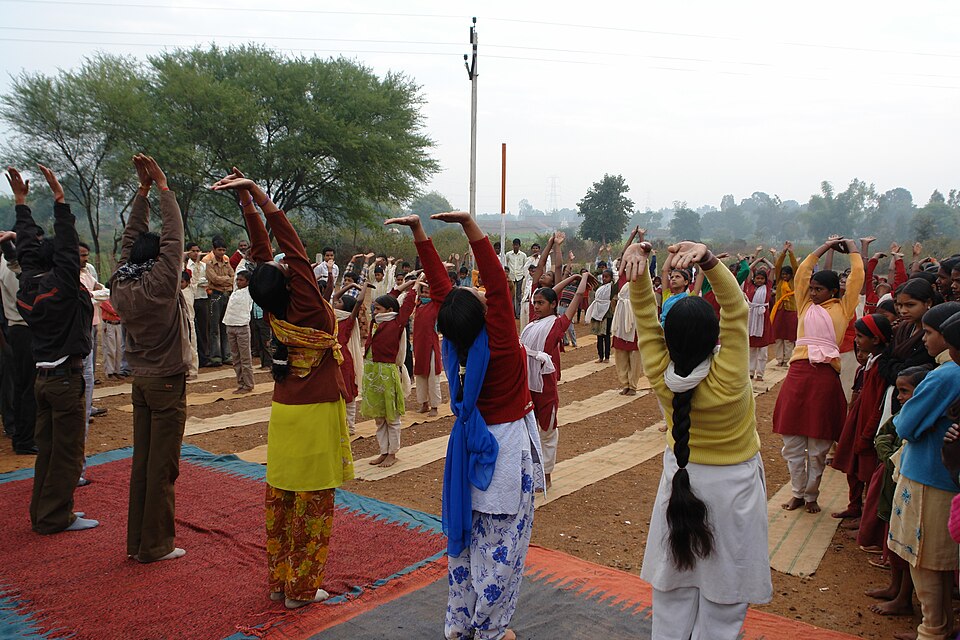
Surya Namaskar — the Sun Salutation — is a flowing sequence traditionally offered to the rising sun. Linking movement with breath, it warms the whole body, and a few rounds make a complete practice in themselves. It is the beating heart of Indian yoga culture.
Name meaning: From Sūrya meaning "sun" (the Hindu solar deity) and Namaskāra meaning "greeting" or "salute" — the "salute to the sun".
Classification: Sequence (vinyasa) — a flowing series of about twelve linked asanas, not a single posture.
Tradition & origin: The precise origins of the modern flowing sequence are uncertain. It was popularised and named in the 1920s by Bhawanrao Shriniwasrao Pant Pratinidhi, the Rajah of Aundh (his 1928 book The Ten-Point Way to Health), and adopted into yoga by Krishnamacharya in Mysore — where, tellingly, the sun-salutation classes were not then considered "yoga". Ancient sun-worship such as the Aditya Hridayam (in the Ramayana) is unrelated to this physical sequence. So the flow is best described as an early-20th-century practice, however deep the cultural reverence for the sun behind it.
This guide was drafted with the help of AI and reviewed by us. It is for general education only and is not medical or professional advice. It may contain errors. Please practise mindfully, listen to your body, and consult a qualified yoga teacher or doctor for anything specific. Spotted an error? Tell us in the comments below.
How to do it — step by step
- 1Pranamasana — stand tall, palms together at the heart.
- 2Hasta Uttanasana — inhale, sweep the arms up and gently arch back.
- 3Uttanasana — exhale, fold forward from the hips.
- 4Ashwa Sanchalanasana — inhale, step one leg back into a lunge, chest lifting.
- 5Dandasana / Plank — hold the breath, step back to a straight line.
- 6Ashtanga Namaskar — exhale, lower knees, chest and chin to the floor.
- 7Bhujangasana — inhale, slide forward and lift the chest into Cobra.
- 8Adho Mukha Svanasana — exhale, lift the hips into Downward Dog.
- 9Ashwa Sanchalanasana — inhale, step the foot forward into a lunge.
- 10Uttanasana — exhale, step feet together and fold.
- 11Hasta Uttanasana — inhale, rise and reach up.
- 12Pranamasana — exhale, return palms to the heart. Repeat leading with the other leg.
Breath & hold
One breath per movement, as marked above. Begin with 3–6 rounds and build gradually. Move smoothly, never rushing the breath.
Benefits
- ✓A full-body warm-up that builds flexibility and strength together.
- ✓Links breath and movement, focusing the mind.
- ✓Stimulates circulation and digestion when done on an empty stomach.
- ✓Energising in the morning; a complete short practice on busy days.
🪔 The traditional / desi way
- Traditionally performed at sunrise, facing east, as an offering of gratitude to Surya (the sun).
- Each round is often paired with one of the twelve solar mantras (Om Mitraya Namaha, Om Ravaye Namaha…), chanted silently.
- In many Indian homes and schools children learn a set of rounds daily — it is as much culture as exercise.
Common mistakes
- ✕Rushing so the breath falls out of sync with the movement.
- ✕Forcing the backbends instead of lengthening first.
- ✕Skipping the warm-up on a cold body.
Muscles & anatomy
- 💪A whole-body sequence: legs, hips, spine, shoulders and arms all work across the round.
- 💪Energy cost varies widely with pace — from light (about 3 METs) to vigorous (over 7 METs) with jumps and full push-ups.
- 💪Muscle-use studies show experienced practitioners recruit shoulder and knee-stabilising muscles more efficiently than beginners.
What you may feel
- 🫧Normal: warming up, a raised heart rate, and breath synced to movement.
- 🫧Warning sign: breathlessness that breaks the breath rhythm, dizziness, or joint pain — slow down, reduce rounds, or rest.
Variations to grow into
Add more rounds and a light jump between the fold and plank stages to raise the intensity, keeping the breath steady.
Practise the more demanding Ashtanga forms (Surya Namaskar A and B) with full vinyasa transitions — vigorous and best learned with guidance.
Using props
- 🧱A wall or chair for a supported, standing-only version.
- 🧱Blocks under the hands in the folds to protect the lower back.
Warm-up & counterpose
- A couple of very slow, gentle rounds count as their own warm-up.
- Add Cat–Cow and ankle/wrist mobility on a cold body.
- Finish a session of rounds with a forward fold and then rest in Shavasana.
- Gentle twists to settle the spine.
Supporting exercises
Why: Warms the spine and hips before flowing.
How: A few slow rounds of each before starting.
Why: Readies the arms for plank and Cobra stages.
How: Wrist circles and shoulder rolls for 30–60 seconds.
Progression path
Begin with 2–3 slow, modified rounds (knees-down, low backbends). Add rounds over weeks, then introduce pace or jump transitions only once the movements and breath are smooth.
Who it suits — and who should modify
- ✓Beginners, with a slow, modified round (knees down, gentle backbends).
- ✓Most people wanting an efficient whole-body warm-up or short practice.
- ✓Intermediate/advanced practitioners adding rounds and jump transitions for intensity.
- !Modify: high blood pressure — avoid deep back-bends and rapid rounds; keep movements gentle.
- !Modify: late pregnancy — skip prone stages (Cobra, low plank) and take a wide, supported version.
- !Relative caution: back injury or hernia — practise a slow, shortened version with guidance.
- !Wrist issues — take the plank/Cobra stages on the forearms or omit them.
When to practise
Traditionally at sunrise on an empty stomach; practically, any time you can move mindfully before eating.
Suitable most days; 3–6 rounds is a solid daily dose, building up gradually.
Traditional view vs. modern evidence
Offered at sunrise, facing east, as gratitude to Surya; each round is often paired with one of the twelve solar mantras.
The flowing sequence is not in the medieval hatha texts; it was named and popularised in the 1920s–30s.
Recognised as an efficient full-body warm-up and, at pace, a genuine aerobic workout.
Specific disease-curing claims are not established.
Evidence at a glance
Performed briskly, the sequence provides moderate-to-vigorous aerobic exercise.
A systematic review of yoga energy cost found Sun Salutation ranges roughly 3–7+ METs depending on intensity.
As part of yoga practice, it can support fitness, flexibility and wellbeing.
Consistent with NCCIH summaries of yoga overall.
It cures a specific list of diseases.
Early promoters framed it as a health cure; the evidence supports general fitness benefits, not specific cures.
Myths vs. reality
✕ Myth: Surya Namaskar is an ancient Vedic yoga sequence.
✓ Reality: The reverence for the sun is ancient, but this flowing sequence is an early-20th-century creation. Ancient sun-salutations like the Aditya Hridayam are unrelated to it.
✕ Myth: It burns fat from specific body parts.
✓ Reality: It is good general exercise and can raise the heart rate; "spot reduction" is not how the body works.
⚠️ Cautions
- High blood pressure, hernia, back injury or late pregnancy — practise a gentle, modified version with guidance.
- Best on an empty stomach.
Frequently asked questions
How many rounds should I do?
Start with 3–6 rounds and build up over weeks. Even a few slow rounds are beneficial.
Is one round both legs?
Usually one full round leads with one leg; the next round leads with the other, so they balance in pairs.
What time is best?
Traditionally sunrise on an empty stomach, but any time you can move mindfully works.
Key takeaways
- ⭐A flowing 12-step sequence that warms the whole body and links breath to movement.
- ⭐At pace it becomes real aerobic exercise (roughly 3–7+ METs).
- ⭐An early-20th-century practice — the sun-worship behind it is ancient, the flow is modern.
- ⭐Start with a few slow rounds; modify prone stages in pregnancy and with back/wrist issues.
References
- Wikipedia — Sun Salutation (etymology & origins, sourced to Singleton, Yoga Body; Pant Pratinidhi 1928) · Encyclopaedia, scholarly-sourced
- Larson-Meyer 2016, "A Systematic Review of the Energy Cost and Metabolic Intensity of Yoga", Med Sci Sports Exerc · Peer-reviewed systematic review
- NCCIH — Yoga: What You Need To Know · Government health body (public domain)
Sources are provided for further reading; always consult a qualified teacher or clinician for personal guidance.
📝 Your private notes
Saved only on this device — jot down what helped.
💬 Improvements, corrections & suggestions
Found an error or have a better cue? Share it — practitioners help make each guide more accurate.
No comments yet — be the first to help improve this guide.