DAILY YOGA · Tadasana
Mountain Pose
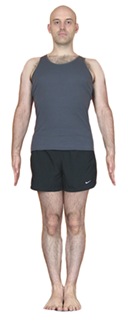
Tadasana — Mountain Pose — looks like "just standing", but it is the blueprint for every standing posture. It teaches you to stack the body with ease, ground evenly through the feet, and stand tall like a mountain: steady, rooted and unhurried.
Name meaning: From tāḍa meaning "mountain" and āsana meaning "posture" or "seat". Its other name, Samasthiti, joins sama ("equal", "level") and sthiti ("standing") — "to stand in balance".
Classification: Asana — the foundational standing posture on which most other standing poses are built.
Tradition & origin: Tadasana is not described in the medieval hatha-yoga texts; it is part of modern yoga as exercise. A standing posture of this kind appears in the 1896 gymnastics manual Vyāyāma Dīpikā among the "very old" danda (staff) exercises, and it entered modern practice through Krishnamacharya's teaching in Mysore as the foundation for flowing vinyasa. It is best presented as a modern foundational posture rather than an ancient named asana.
This guide was drafted with the help of AI and reviewed by us. It is for general education only and is not medical or professional advice. It may contain errors. Please practise mindfully, listen to your body, and consult a qualified yoga teacher or doctor for anything specific. Spotted an error? Tell us in the comments below.
How to do it — step by step
- 1Stand with feet together or hip-width apart, weight even on both feet.
- 2Spread the toes and feel four corners of each foot press down.
- 3Gently firm the thighs and lift the kneecaps without locking the knees.
- 4Lengthen the tailbone down and draw the lower belly softly in.
- 5Stack the ribs over the hips, and the head over the shoulders.
- 6Roll the shoulders up, back and down; let the arms hang, palms facing forward.
- 7Lift through the crown of the head as if a thread draws you upward.
Breath & hold
Breathe naturally and evenly. Hold for 30–60 seconds, feeling the breath rise and fall without disturbing the stillness.
Benefits
- ✓Improves posture and body awareness.
- ✓Strengthens the legs, ankles and core stabilisers.
- ✓Teaches even grounding, reducing everyday slouching.
- ✓Calms and centres the mind before practice.
🪔 The traditional / desi way
- Old teachers call it the "sama" (equal) standing — the body in perfect balance, like the still centre of a scale.
- A classic cue from Indian gurukuls: "stand like Mount Meru" — the mythic mountain at the centre of the universe, unmoving and dignified.
- Practised barefoot on the earth at dawn, it is said to draw steadiness from the ground upward.
Common mistakes
- ✕Locking the knees hard back.
- ✕Letting the ribs flare and the lower back over-arch.
- ✕Collapsing the chest or jutting the chin forward.
Modifications & props
- 🧩Stand with feet hip-width for more stability.
- 🧩Practise against a wall to learn the vertical alignment.
Muscles & anatomy
- 💪Legs: quadriceps and calves gently engage; the small muscles of the feet and ankles work to balance.
- 💪Core: the deep abdominal and back muscles co-contract to hold the spine tall.
- 💪Upper body: the muscles around the shoulder blades draw the shoulders down and open the chest.
What you may feel
- 🫧Normal: a feeling of lightness and length, even grounding through both feet, and steady, easy breathing.
- 🫧Normal: subtle sway as the balancing muscles fine-tune — this is the pose working.
- 🫧Warning sign: dizziness or locking-knee discomfort — soften the knees and shorten the hold.
Variations to grow into
Urdhva Hastasana: on an inhale, sweep the arms overhead and lightly gaze up, keeping the ribs from flaring — the same alignment, lengthened upward.
Rise onto the balls of the feet (as in some Ashtanga versions) and hold the vertical line, or add a gentle standing back-bend (Anuvittasana). Build the balance slowly and keep the lower back long.
Using props
- 🧱A wall behind you to learn the vertical stack (heels, hips, shoulders, head lightly touching).
- 🧱A block between the thighs to feel the legs engaging evenly.
Warm-up & counterpose
- A few slow neck and shoulder rolls.
- Gentle ankle rocking to wake the feet.
- None needed — Tadasana is itself a neutral, resting posture that other poses return to.
Supporting exercises
Why: Teaches even grounding through the base of the big toe, little toe and heel.
How: Standing, rock gently forward, back and side to side, then settle where the weight feels even; 30–60 seconds.
Why: Builds the feel of a neutral, tall spine.
How: Stand with heels a few inches from a wall; bring hips, upper back and head lightly to the wall and breathe for 5 breaths.
Progression path
Master even grounding and a tall, easy spine first. From there, add the arms overhead (Urdhva Hastasana), then explore rising to the toes or a small back-bend as balance improves.
Who it suits — and who should modify
- ✓Everyone, including complete beginners — it is the reference posture for good alignment.
- ✓Older adults and anyone rebuilding balance and posture (stand near a wall if needed).
- ✓A grounding pause between other standing poses.
- !Generally suitable for all; there are no specific contraindications for gentle standing.
- !Relative caution: if you have low blood pressure and feel light-headed standing still, keep a soft bend in the knees and avoid long holds.
- !Modify: balance difficulties — stand with feet hip-width or beside a wall.
When to practise
Any time. Often used at the very start of a practice to settle and align, and between standing poses to reset.
Safe to practise daily and as often as you like; it doubles as an everyday posture check.
Traditional view vs. modern evidence
Taught as the steady, balanced "equal standing" (Samasthiti) — the dignified, mountain-like base of the standing practice.
Not found in the medieval hatha texts; it is a modern foundational posture (documented from late-19th-/20th-century sources).
Valued for training alignment, grounding and balance; a sensible base for stronger standing poses.
Claims that standing alone permanently fixes posture are overstated.
Evidence at a glance
Posture-focused and balance work like standing alignment practice can support balance and body awareness.
The NCCIH notes yoga may help improve balance; Tadasana is a basic building block of that work.
Holding Tadasana permanently "corrects" posture on its own.
It builds awareness and supporting strength, but lasting posture change needs regular, varied practice.
Myths vs. reality
✕ Myth: Standing still is not "real" yoga.
✓ Reality: Tadasana trains the alignment and grounding that make every other posture safer; it is deceptively active.
✕ Myth: You must always place the feet together.
✓ Reality: Feet together is the classical form, but hip-width is equally valid and often better for balance and lower-back comfort.
⚠️ Cautions
- Generally safe for everyone. If you have low blood pressure and feel light-headed standing still, keep a slight bend in the knees.
Frequently asked questions
Is Mountain Pose really a pose?
Yes — it is the reference posture for alignment. Learning it well makes every other standing pose safer and steadier.
Feet together or apart?
Both are traditional. Feet together is classical; hip-width is friendlier for balance and lower-back comfort.
Key takeaways
- ⭐The blueprint standing posture: even grounding, tall spine, easy breath.
- ⭐Learning it well makes every other standing pose steadier and safer.
- ⭐A modern foundational posture, not an ancient named asana.
- ⭐Suitable for everyone; soften the knees if standing still makes you light-headed.
References
- Wikipedia — Tadasana (etymology & origins, sourced to Sjoman, Yoga Tradition of the Mysore Palace) · Encyclopaedia, scholarly-sourced
- NCCIH — Yoga: What You Need To Know · Government health body (public domain)
Sources are provided for further reading; always consult a qualified teacher or clinician for personal guidance.
📝 Your private notes
Saved only on this device — jot down what helped.
💬 Improvements, corrections & suggestions
Found an error or have a better cue? Share it — practitioners help make each guide more accurate.
No comments yet — be the first to help improve this guide.