DAILY YOGA · Urdhva Dhanurasana
Wheel / Upward Bow
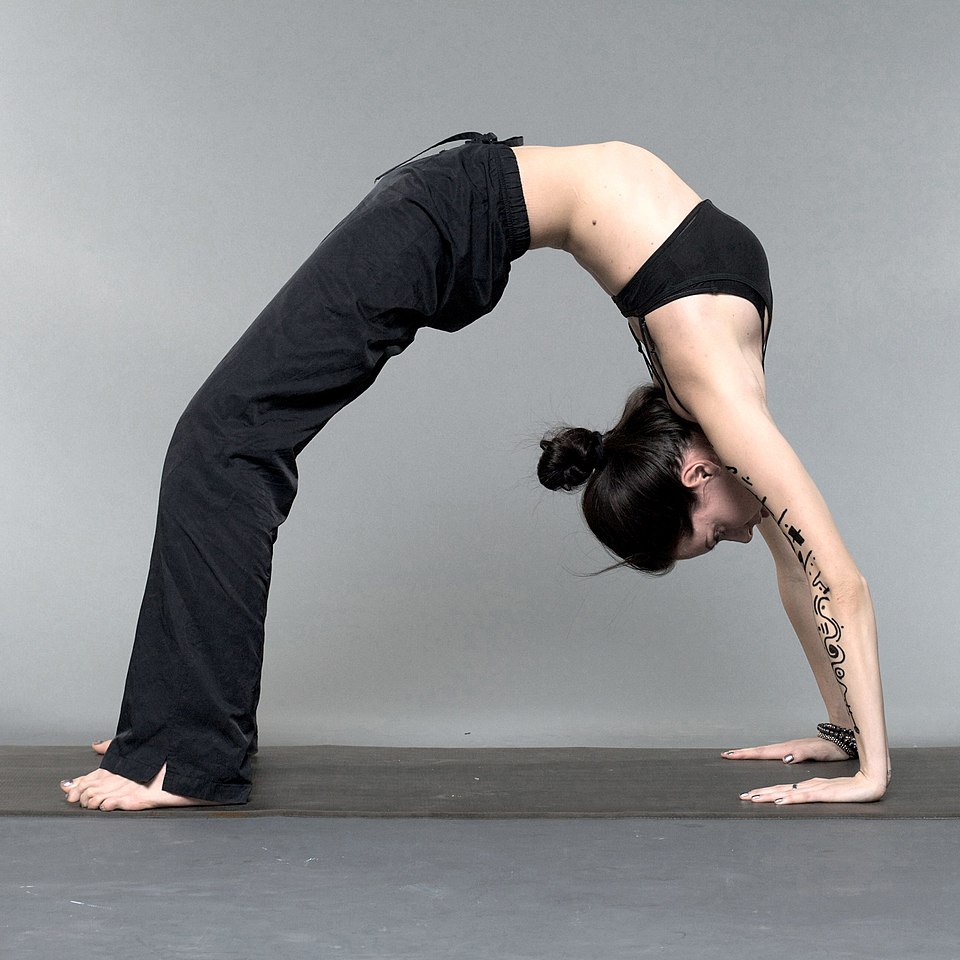
Urdhva Dhanurasana — Upward Bow, commonly called Wheel — is a deep, energising full backbend where you press up from lying down into a high arch on hands and feet. It powerfully opens the whole front body and demands warm, mobile shoulders and spine.
Name meaning: From ūrdhva meaning "upward" and dhanura meaning "bow" (for archery), with āsana — the "upward-facing bow posture". Also called Chakrasana, from cakra meaning "wheel".
Classification: Asana — a deep full backbend (an advanced pose).
Tradition & origin: The modern Wheel is illustrated in the 19th-century Sritattvanidhi under the name Paryankasana ("Couch Pose"), and the deep full-backbend form as practised today belongs to modern yoga (e.g. Light on Yoga). The names (Chakrasana / Urdhva Dhanurasana) and the deep expression are best treated as modern, with a 19th-century illustrated antecedent.
This guide was drafted with the help of AI and reviewed by us. It is for general education only and is not medical or professional advice. It may contain errors. Please practise mindfully, listen to your body, and consult a qualified yoga teacher or doctor for anything specific. Spotted an error? Tell us in the comments below.
How to do it — step by step
- 1Lie on the back, knees bent, feet flat and hip-width.
- 2Bend the elbows and place the palms by the ears, fingers toward the shoulders.
- 3Press the feet and hands down; lift the hips and rest the crown lightly on the floor.
- 4Pause, then press fully up, straightening the arms.
- 5Keep the feet parallel and the knees tracking forward.
- 6Lengthen the tailbone and lift the chest through the shoulders.
- 7Come down with control, tucking the chin, and rest before repeating.
Breath & hold
Breathe steadily throughout; hold 5–15 seconds and build up. Rest between repetitions.
Benefits
- ✓Deeply opens the chest, shoulders and hip flexors.
- ✓Strengthens the arms, legs, glutes and back.
- ✓Energising and often mood-lifting.
- ✓Improves spinal extension and mobility.
🪔 The traditional / desi way
- The "upward bow" — the body drawn into a taut arc, full of stored energy, the deepest of the common backbends.
- Traditional wisdom: warm up thoroughly first (Cobra, Bridge, Camel) and open the shoulders — never force the deepest backbend cold.
Common mistakes
- ✕Letting the knees splay out and feet turn out.
- ✕Crunching the lower back instead of spreading the arch.
- ✕Not warming up the shoulders and spine first.
Modifications & props
- 🧩Practise Bridge Pose (Setu Bandhasana) as a gentler alternative.
- 🧩Use blocks against a wall under the hands (angled) to ease the wrists and shoulders.
Muscles & anatomy
- 💪Working: the spinal extensors, glutes and hamstrings lift the hips; the shoulders and arms press the chest through.
- 💪Stretched: the whole front body — chest, abdomen, hip flexors and quadriceps — and the shoulders in deep flexion.
- 💪Open shoulders and hips let the load spread along the spine rather than pooling in the lower back.
What you may feel
- 🫧Normal: a big, whole-front-body opening and strong effort in the legs, back and shoulders.
- 🫧Warning sign: lower-back compression, wrist or shoulder pain — come down; build shoulder/hip openness and practise Bridge.
Variations to grow into
Press up only partway (crown lightly down) before straightening the arms, or walk the feet closer to lift higher as mobility allows.
Eka Pada Urdhva Dhanurasana (one leg lifted), or dropping back from standing / coming up to stand — for very advanced, well-supervised practitioners.
Using props
- 🧱Blocks (angled) against a wall under the hands to ease the wrists and shoulders.
- 🧱Bridge Pose as the accessible, gentler alternative.
Warm-up & counterpose
- Thorough backbend prep: Cobra/Up Dog, Locust, Bow and Bridge.
- Shoulder, hip-flexor and quad openers; never attempt cold.
- Knees to the chest and a gentle supine twist to release the lower back.
- A supported forward fold or Child's Pose.
Supporting exercises
Why: Builds the back/glute strength and chest opening toward Wheel.
How: Lift and hold the hips several times, 20–30 seconds.
Why: Frees the shoulders so the arms can straighten overhead.
How: Doorway or strap overhead-shoulder stretches, 20–30 seconds each.
Progression path
Master Bridge and shoulder/hip openness first; then press to the crown, then straighten the arms with hands angled or on blocks; increase height only as the backbend stays comfortable across the whole spine.
Who it suits — and who should modify
- ✓Advanced and well-prepared intermediate practitioners with open shoulders, hips and spine, and healthy wrists.
- ✓Most people are better served by Bridge Pose until the backbend and shoulders open.
- !Absolute caution: back, wrist, shoulder or neck injury; uncontrolled high or low blood pressure; pregnancy — practise Bridge instead.
- !This is an advanced backbend — build up gradually and never force.
- !Come out slowly to avoid dizziness.
When to practise
When thoroughly warm, later in an active practice — never cold. Not on a full stomach.
An occasional peak backbend as your practice allows; Bridge can be practised far more often.
Traditional view vs. modern evidence
A "wheel" of the arched body; deep backbends are prized in modern practice as opening and energising.
Illustrated in the 19th-century Sritattvanidhi (as Paryankasana); the deep modern form is 20th-century.
Recognised as an advanced backbend needing shoulder and hip openness; Bridge is the safer building block.
Emotional/chakra-healing claims are not established.
Evidence at a glance
Wheel strongly opens the front body and builds back, glute and shoulder strength.
Consistent with the biomechanics of a deep backbend.
Forcing Wheel without mobility strains the lower back and wrists.
Widely observed by teachers/clinicians; open shoulders/hips are protective.
Myths vs. reality
✕ Myth: Wheel opens the "heart chakra" to heal emotional blocks.
✓ Reality: A big backbend can feel energising and emotional, but specific chakra-healing claims are not established.
✕ Myth: Push higher to prove your backbend.
✓ Reality: Depth without open shoulders and hips pools strain in the lower back and wrists; build mobility first.
⚠️ Cautions
- Back, wrist, shoulder or neck injury, high/low blood pressure, or pregnancy — avoid or practise Bridge instead. This is an advanced backbend; build up gradually.
Frequently asked questions
I cannot straighten my arms — why?
Usually tight shoulders. Keep working shoulder-opening poses and Bridge; arm extension comes with mobility, not force.
My wrists hurt — what can I do?
Angle the hands slightly outward, or place them on a low wedge/blocks against a wall. Warm the wrists up first.
Key takeaways
- ⭐A deep full backbend that opens the whole front body — an advanced pose.
- ⭐Open the shoulders and hips first; build from Bridge, and never force depth.
- ⭐Modern in its deep form (with a 19th-century illustrated antecedent).
- ⭐Avoid with back, wrist, shoulder, neck, blood-pressure or pregnancy concerns.
References
- Wikipedia — Chakrasana / Urdhva Dhanurasana (etymology & origins) · Encyclopaedia, scholarly-sourced
- NCCIH — Yoga: What You Need To Know · Government health body (public domain)
Sources are provided for further reading; always consult a qualified teacher or clinician for personal guidance.
📝 Your private notes
Saved only on this device — jot down what helped.
💬 Improvements, corrections & suggestions
Found an error or have a better cue? Share it — practitioners help make each guide more accurate.
No comments yet — be the first to help improve this guide.