DAILY YOGA · Urdhva Mukha Svanasana
Upward-Facing Dog
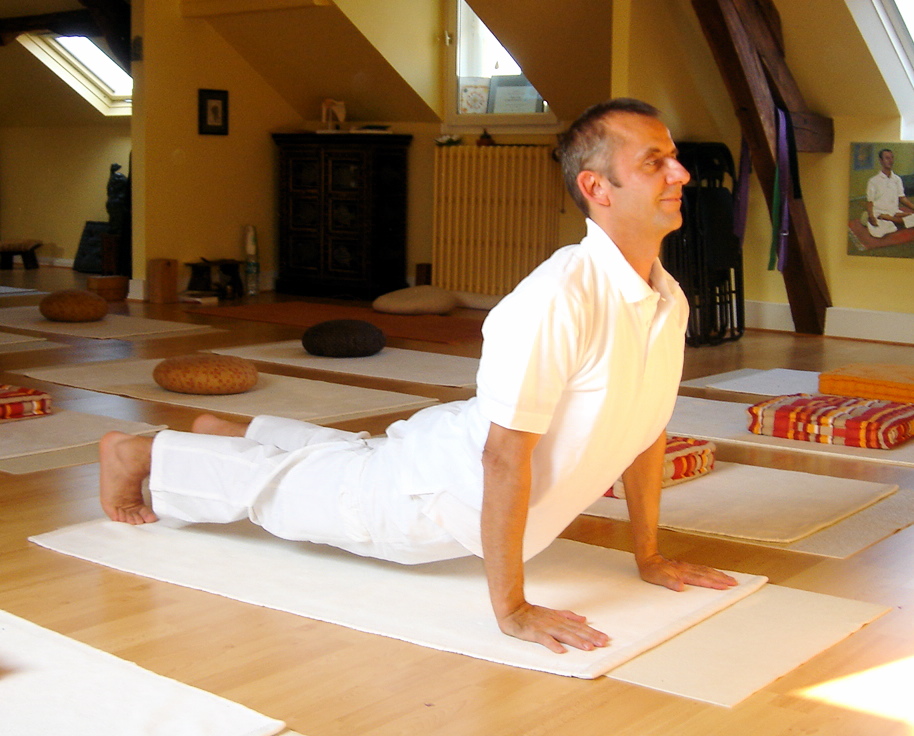
Urdhva Mukha Svanasana — Upward-Facing Dog — is an energising backbend that opens the chest and strengthens the arms, with the thighs lifted off the floor and the weight in the hands and tops of the feet. It flows through most vinyasa sequences as the "up dog" after Chaturanga.
Name meaning: From ūrdhva meaning "upward", mukha meaning "face", śvāna meaning "dog" and āsana meaning "posture" — the "upward-facing dog posture", named for the way a dog stretches with its chest lifted.
Classification: Asana — a backbend and arm/shoulder strengthener; the "up dog" of vinyasa flow.
Tradition & origin: Like Downward Dog, Upward-Facing Dog is one of the poses introduced into modern yoga by Krishnamacharya in the mid-20th century and spread by his pupils Pattabhi Jois and B. K. S. Iyengar; it is not found in the medieval hatha texts. Present it as modern postural yoga.
This guide was drafted with the help of AI and reviewed by us. It is for general education only and is not medical or professional advice. It may contain errors. Please practise mindfully, listen to your body, and consult a qualified yoga teacher or doctor for anything specific. Spotted an error? Tell us in the comments below.
How to do it — step by step
- 1Lie on the belly, tops of the feet down, hands beside the lower ribs.
- 2Point the toes back and press the tops of the feet down.
- 3Inhale and straighten the arms, lifting the chest and thighs off the floor.
- 4Only the hands and tops of the feet touch the ground.
- 5Roll the shoulders back and down; broaden across the collarbones.
- 6Lengthen the tailbone toward the heels to protect the lower back.
- 7Gaze forward, keeping the back of the neck long.
Breath & hold
Inhale to rise into it; move on the breath in a flow, or hold for a few smooth breaths.
Benefits
- ✓Strengthens the arms, wrists and back.
- ✓Opens the chest, shoulders and front of the body.
- ✓Improves posture and counters slouching.
- ✓Energising within a flowing practice.
🪔 The traditional / desi way
- The "upward-facing dog" completes the pair with Downward Dog — one lifts the heart to the sky, the other bows it toward the earth.
- Traditional cue: press the floor away to lift the whole body — never let the thighs or belly drag along the mat.
Common mistakes
- ✕Leaving the thighs on the floor (that is Cobra, not Up Dog).
- ✕Hunching the shoulders up by the ears.
- ✕Crunching the lower back instead of lengthening the tailbone down.
Modifications & props
- 🧩Practise Cobra (Bhujangasana) for a gentler chest-opening version.
- 🧩Keep the lift modest and focus on shoulders rolling back.
Muscles & anatomy
- 💪Working: the arms (triceps), shoulders and the spinal extensors lift and hold the chest.
- 💪The quadriceps and glutes stay firm to lift the thighs off the floor and protect the lower back.
- 💪Stretched: the chest, front of the shoulders and the abdominals.
What you may feel
- 🫧Normal: an open chest, working arms and a lifted, supported backbend.
- 🫧Warning sign: lower-back compression or wrist pain — lift the thighs more, roll the shoulders down, or switch to low Cobra.
Variations to grow into
Flow smoothly between Up Dog and Down Dog with the breath, keeping the thighs lifted and shoulders drawing down.
Longer holds with a fuller chest-lift as part of deeper backbend practice — with a stable, pain-free base.
Using props
- 🧱Blocks under the hands to ease the wrists and lift the chest higher.
- 🧱Low Cobra as the accessible alternative while building strength.
Warm-up & counterpose
- Cat–Cow and low Cobra to warm the spine.
- Wrist mobility.
- Child's Pose (Balasana) or Downward Dog to release the lower back and shoulders.
Supporting exercises
Why: Builds back-extension strength before the arm-supported lift.
How: Hold a low backbend for 20–30 seconds, leading with the chest.
Why: Prepares the wrists for the weight-bearing lift.
How: Gentle wrist circles, stretches and light all-fours weight-bearing.
Progression path
Begin with low Cobra to build back strength, then Up Dog with blocks under the hands, then the full pose with lifted thighs — adding hold time as the back stays comfortable.
Who it suits — and who should modify
- ✓Intermediate practitioners flowing through vinyasa sequences.
- ✓Those with a comfortable backbend base and healthy wrists.
- ✓Desk workers wanting to open a rounded chest (build up gradually).
- !Modify / avoid: wrist injury or carpal tunnel — take low Cobra instead.
- !Modify: lower-back injury — keep the legs strong and the backbend moderate, or choose low Cobra.
- !Modify: pregnancy — avoid the prone lift; use a gentler chest-opener.
When to practise
Any time once warm; it recurs many times within vinyasa flows.
Safe most days; brief holds, or as it appears in a flow.
Traditional view vs. modern evidence
Paired with Downward Dog in modern flows; taught as a heart-opening lift.
Not in the medieval hatha texts; introduced by Krishnamacharya in the mid-20th century.
Valued as a chest-opening backbend and arm strengthener within vinyasa.
Specific therapeutic claims beyond strengthening and opening are limited.
Evidence at a glance
Up Dog strengthens the arms and back and opens the chest.
Consistent with the biomechanics of an arm-supported backbend.
It counters the effects of forward-hunched sitting.
Plausible and widely taught; direct pose-specific evidence is limited.
Myths vs. reality
✕ Myth: Up Dog and Cobra are the same.
✓ Reality: In Up Dog the thighs lift off the floor and the arms are straight; in Cobra the legs stay down and the back does more of the work.
✕ Myth: It is an ancient asana.
✓ Reality: It is modern postural yoga (Krishnamacharya, mid-20th century), not a medieval pose.
⚠️ Cautions
- Back injury, carpal tunnel, or pregnancy — practise Cobra or Sphinx instead.
Frequently asked questions
How is Up Dog different from Cobra?
In Up Dog the thighs lift and only the hands and feet touch the floor, with straight arms. In Cobra the legs and often the pelvis stay down and the back muscles do more of the work.
My shoulders creep up — how do I fix that?
Roll the shoulders back and down and broaden the collarbones; imagine drawing the chest forward through the arms.
Key takeaways
- ⭐A chest-opening backbend and arm strengthener — the "up dog" of vinyasa.
- ⭐Lift the thighs off the floor and roll the shoulders down; not the same as Cobra.
- ⭐Modern postural yoga (Krishnamacharya), not a classical asana.
- ⭐Use blocks or low Cobra to modify for wrists or lower back.
References
- Wikipedia — Cobra pose (covers Urdhva Mukha Svanasana etymology & Krishnamacharya origin) · Encyclopaedia, scholarly-sourced
- NCCIH — Yoga: What You Need To Know · Government health body (public domain)
Sources are provided for further reading; always consult a qualified teacher or clinician for personal guidance.
📝 Your private notes
Saved only on this device — jot down what helped.
💬 Improvements, corrections & suggestions
Found an error or have a better cue? Share it — practitioners help make each guide more accurate.
No comments yet — be the first to help improve this guide.