DAILY YOGA · Utkatasana
Chair Pose
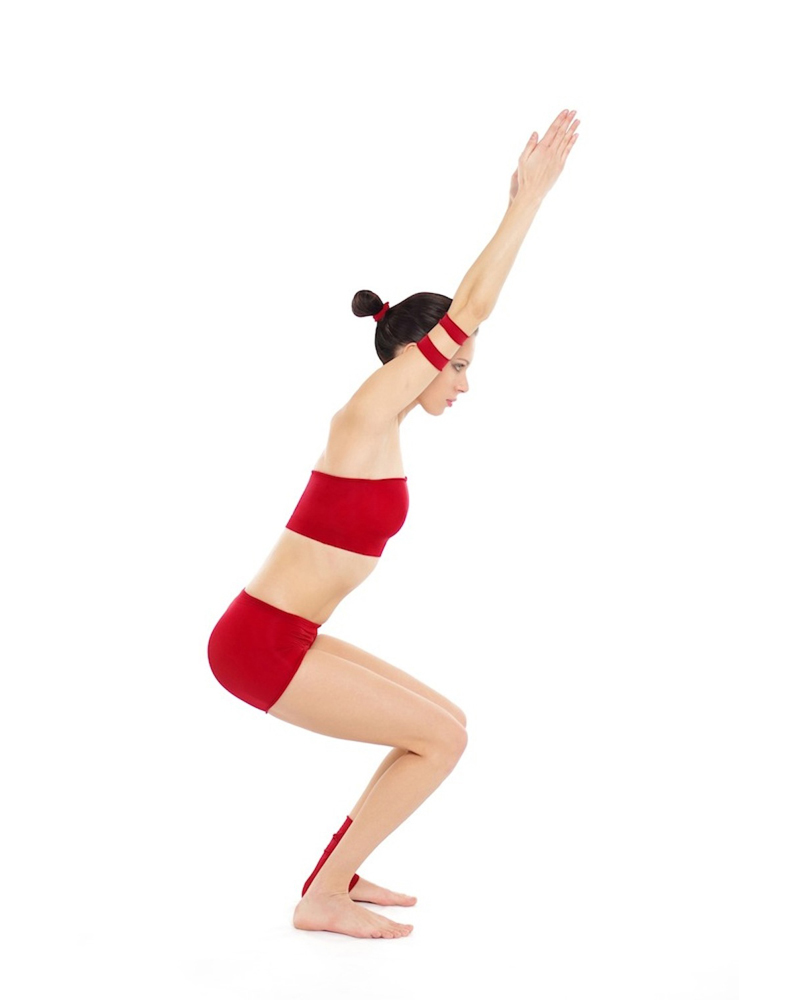
Utkatasana — Chair Pose — is a strong standing posture that looks like sitting back into an invisible chair. It builds heat and strength through the legs, glutes and core while teaching you to stay steady under effort. "Utkata" means powerful or fierce.
Name meaning: From utkaṭa meaning "fierce", "powerful" or "intense" and āsana meaning "posture" — the "fierce posture", sometimes called Chair Pose in English for its sit-back shape.
Classification: Asana — a standing strength pose (a squat-like, quad-and-glute builder).
Tradition & origin: The name is old but the shape has changed: a lower squatting pose called Utkatasana appears in the 19th-century Sritattvanidhi, while the modern upright, chair-like form is said to originate with Krishnamacharya in the 20th century. So the name is traditional; the posture practised today is modern.
This guide was drafted with the help of AI and reviewed by us. It is for general education only and is not medical or professional advice. It may contain errors. Please practise mindfully, listen to your body, and consult a qualified yoga teacher or doctor for anything specific. Spotted an error? Tell us in the comments below.
How to do it — step by step
- 1Stand in Tadasana, feet together or hip-width.
- 2Inhale and sweep the arms up alongside the ears.
- 3Exhale and bend the knees, sitting the hips back and down.
- 4Keep the weight in the heels; you should see your toes.
- 5Lengthen the tailbone down so the lower back does not over-arch.
- 6Lift the chest and reach up through the fingertips.
- 7Hold, breathing steadily, then rise on an inhale.
Breath & hold
Breathe steadily through effort; hold 20–40 seconds. Inhale to lengthen up, exhale to sit deeper.
Benefits
- ✓Strengthens the thighs, glutes, calves and core.
- ✓Builds heat and stamina.
- ✓Improves balance and postural strength.
- ✓Tones the ankles and strengthens the spine.
🪔 The traditional / desi way
- The "fierce" pose — traditionally used to build tapas (disciplined heat), the inner fire that burns away sluggishness.
- Old-school cue: sit as if lowering onto a low stool behind you, chest proud, breath steady in the effort.
Common mistakes
- ✕Letting the knees drift far past the toes and weight fall into the balls of the feet.
- ✕Over-arching the lower back with flared ribs.
- ✕Hunching the shoulders up by the ears.
Modifications & props
- 🧩Keep the arms at the chest or on the hips.
- 🧩Sit less deeply and build over time.
- 🧩Practise with the back near a wall for feedback.
Muscles & anatomy
- 💪Working: the quadriceps, glutes and calves hold the squat; the core and back keep the torso lifted.
- 💪The shoulders work to hold the arms overhead.
- 💪Weight stays in the heels to protect the knees.
What you may feel
- 🫧Normal: a strong burning effort in the thighs and a lifted, upright torso.
- 🫧Warning sign: knee pain or lower-back arching — sit back less, drop the ribs, and keep weight in the heels.
Variations to grow into
Deepen the sit-back toward thighs-parallel and lengthen the hold, keeping the chest lifted.
Parivrtta Utkatasana (Revolved Chair): hook an elbow across the opposite knee and twist — a distinct, more demanding variation.
Using props
- 🧱A block between the thighs to keep the knees tracking evenly.
- 🧱A wall behind you to learn sitting the hips back safely.
Warm-up & counterpose
- A few gentle squats and ankle mobility.
- Sun-Salutation rounds to warm the legs.
- A standing forward fold to release the thighs and lower back.
- A gentle back-bend such as a small standing chest-opener.
Supporting exercises
Why: Builds the leg strength Chair Pose demands.
How: Sit the hips back and down 10–15 times, weight in the heels.
Why: Trains the static leg endurance of the hold.
How: Slide down a wall to a comfortable angle and hold 20–40 seconds.
Progression path
Start with a shallow, brief hold and hands on the hips; deepen the sit-back and add the arms overhead and a longer hold as leg strength grows.
Who it suits — and who should modify
- ✓Beginners, holding briefly and sitting back only as far as is comfortable.
- ✓Most people building leg and core strength.
- ✓Those wanting a quick, effective standing strengthener.
- !Modify: knee injury — keep the sit-back shallow and the knees tracking over the feet.
- !Relative caution: low back pain — keep the ribs down and avoid over-arching.
- !Relative caution: shoulder issues — take the arms lower or shoulder-width instead of overhead.
When to practise
Any time once warm; a good strength builder in the standing part of a practice.
Safe regularly; a couple of holds is plenty to feel the work.
Traditional view vs. modern evidence
The "fierce posture" — powerful and stimulating, its lifted shape likened to a lightning bolt.
A lower squatting Utkatasana appears in the 19th-century Sritattvanidhi; the modern upright form is 20th-century.
Valued as an efficient standing strengthener for the legs and core.
No specific medical claims beyond strength and fitness are established.
Evidence at a glance
Chair Pose builds lower-body and core strength.
Consistent with exercise-physiology evidence for sustained squat-type holds.
It supports general fitness and posture as part of yoga.
Per NCCIH summaries of yoga overall.
Myths vs. reality
✕ Myth: Chair Pose is an ancient meditation posture.
✓ Reality: The name is old but referred to a low squat; the modern chair-like strength pose is 20th-century (Krishnamacharya).
✕ Myth: Knees over the toes is always wrong.
✓ Reality: A little forward travel is fine for many bodies; the key cues are weight in the heels and a lifted torso — not a rigid rule.
⚠️ Cautions
- Knee injury — reduce the depth of the bend. Low blood pressure — rise slowly.
Frequently asked questions
Where should my weight be?
In the heels — if you can wiggle your toes, you are grounding correctly and protecting the knees.
Knees or toes — which come first?
Aim to keep the knees roughly over the ankles and sit the hips back, rather than letting the knees shoot forward past the toes.
Key takeaways
- ⭐A "fierce" standing strengthener for the thighs, glutes and core.
- ⭐Sit the hips back with weight in the heels and the torso lifted.
- ⭐The name is old (a low squat); the modern chair-like form is 20th-century.
- ⭐Shorten the hold or raise the hands to modify for knees, back or shoulders.
References
- Wikipedia — Utkatasana (etymology & origins) · Encyclopaedia, scholarly-sourced
- NCCIH — Yoga: What You Need To Know · Government health body (public domain)
Sources are provided for further reading; always consult a qualified teacher or clinician for personal guidance.
📝 Your private notes
Saved only on this device — jot down what helped.
💬 Improvements, corrections & suggestions
Found an error or have a better cue? Share it — practitioners help make each guide more accurate.
No comments yet — be the first to help improve this guide.