DAILY YOGA · Utthita Trikonasana
Triangle Pose
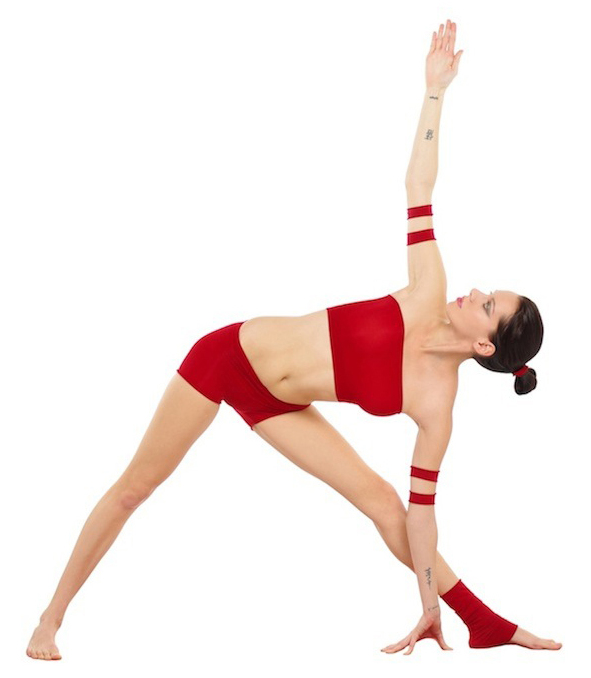
Utthita Trikonasana — Extended Triangle Pose — is a classic standing posture that stretches the whole side body while strengthening the legs. It creates length, openness and a bright, expansive feeling across the chest.
Name meaning: From utthita meaning "extended", trikoṇa meaning "triangle", and āsana meaning "posture" — the "extended triangle posture", named for the triangular shapes the legs and torso make.
Classification: Asana — a standing pose combining a side-bend, a lateral stretch and a gentle twist.
Tradition & origin: Triangle is first described in the 20th century — it appears in the teaching of Krishnamacharya, including his 1934 book Yoga Makaranda, and in his students' works. It is a modern posture rather than one from the medieval hatha texts.
This guide was drafted with the help of AI and reviewed by us. It is for general education only and is not medical or professional advice. It may contain errors. Please practise mindfully, listen to your body, and consult a qualified yoga teacher or doctor for anything specific. Spotted an error? Tell us in the comments below.
How to do it — step by step
- 1Step the feet wide, arms out at shoulder height.
- 2Turn the front foot out 90°, back foot slightly in.
- 3Keep both legs straight and strong.
- 4Reach the front arm forward, then hinge at the front hip.
- 5Lower the front hand to the shin, a block, or the floor.
- 6Extend the top arm straight up, stacking the shoulders.
- 7Lengthen both sides of the waist evenly; gaze up, forward or down.
Breath & hold
Breathe evenly into the top lung; hold 30 seconds each side. Come up on an inhale with a strong core.
Benefits
- ✓Stretches the legs, hips, groins and side body.
- ✓Strengthens the thighs and improves stability.
- ✓Opens the chest and shoulders.
- ✓Encourages full, even breathing across the ribs.
🪔 The traditional / desi way
- The "trikona" (triangle) is a stable, sacred shape — the pose builds the same steadiness through a broad, grounded base.
- Traditional cue: think length, not depth — reach the crown and the tailbone away from each other rather than reaching for the floor.
Common mistakes
- ✕Collapsing the chest toward the floor — keep it open toward the ceiling.
- ✕Reaching so low that the waist crunches; use a block.
- ✕Locking or hyper-extending the front knee.
Modifications & props
- 🧩Rest the lower hand on a block or the shin instead of the floor.
- 🧩Practise with the back against a wall to learn to open the chest.
Muscles & anatomy
- 💪Stretched: the hamstrings and inner thigh of the front leg, and the whole side body (obliques, the ribs and the top-arm side).
- 💪Working: the legs stay strong and engaged; the core and back stabilise the long spine.
- 💪The gentle rotation opens the chest toward the ceiling.
What you may feel
- 🫧Normal: a long stretch down the front-leg hamstring and up the top side of the body, and an open chest.
- 🫧Warning sign: strain behind the front knee, neck pinching, or dizziness — bend the knee, lower the gaze, and come up slowly.
Variations to grow into
Lower the hand toward the shin or floor (keeping length in both sides of the torso) and open the chest more fully upward.
Parivrtta Trikonasana (Revolved Triangle): the opposite hand reaches down and the torso twists strongly — a distinct, more demanding pose needing good balance and hamstring length.
Using props
- 🧱A block under the lower hand so the torso stays long instead of collapsing.
- 🧱A wall behind the back to learn the flat, open-chest alignment.
Warm-up & counterpose
- A few standing side-stretches and gentle lunges.
- Hamstring and hip openers.
- A forward fold or Mountain Pose to re-centre.
- A gentle standing twist to balance the rotation.
Supporting exercises
Why: Eases the front-leg hamstring so the torso can lengthen.
How: Hinge over a slightly bent front leg with a long spine; hold 20–30 seconds each side.
Why: Opens the obliques and ribs used in the pose.
How: Reach one arm overhead and lean gently to the side; 20–30 seconds each side.
Progression path
Start with the hand high on the shin or on a block and a soft front knee; over time lower the hand and open the chest further, always keeping both sides of the torso long.
Who it suits — and who should modify
- ✓Beginners, using a block under the lower hand.
- ✓Most intermediate practitioners as a staple standing pose.
- ✓Those wanting to stretch the side body, hamstrings and hips.
- !Modify: neck issues — keep the gaze down or forward rather than up at the top hand.
- !Relative caution: low blood pressure or dizziness — do not linger; rise slowly.
- !Relative caution: recent hamstring or hip injury — keep a soft front knee and a shorter reach.
When to practise
Any time once the body is warm; commonly part of the standing sequence.
Safe to practise regularly; a hold or two per side is enough.
Traditional view vs. modern evidence
Taught in the modern schools (Iyengar, Ashtanga, Sivananda and others), each with slightly different alignment.
Not in the medieval hatha texts; first described in the 20th century (Krishnamacharya, Yoga Makaranda, 1934).
Valued as a whole-body standing stretch for the legs, hips and side body.
No specific medical claims beyond stretching and stability are established.
Evidence at a glance
The pose stretches the hamstrings, hips and side body and builds standing stability.
Consistent with the biomechanics of the shape.
As part of yoga, it supports flexibility and general wellbeing.
Per NCCIH summaries of yoga overall.
Myths vs. reality
✕ Myth: The lower hand must reach the floor.
✓ Reality: Reaching the floor while collapsing the torso is worse than a long spine with the hand on a block. Length matters more than depth.
✕ Myth: Triangle is an ancient scriptural pose.
✓ Reality: It is a 20th-century posture (first described by Krishnamacharya). Its value is real; its claimed antiquity is not.
⚠️ Cautions
- Low blood pressure, neck issues (keep gaze forward or down), or headache — practise gently.
Frequently asked questions
Should my hand reach the floor?
No — reaching the floor is not the point and often makes people collapse the chest. Use a block and keep length and openness.
Straight legs or bent?
Triangle uses straight, strong legs. If the hamstrings are tight, raise the lower hand higher rather than bending the knee.
Key takeaways
- ⭐A whole-body standing stretch for the hamstrings, hips and side body.
- ⭐Keep both sides of the torso long — use a block rather than collapsing to the floor.
- ⭐A modern posture (Krishnamacharya, 1934), not an ancient asana.
- ⭐Lower the gaze for neck comfort and rise slowly if prone to dizziness.
References
- Wikipedia — Trikonasana (etymology & origins, sourced to Mallinson & Singleton, Roots of Yoga) · Encyclopaedia, scholarly-sourced
- NCCIH — Yoga: What You Need To Know · Government health body (public domain)
Sources are provided for further reading; always consult a qualified teacher or clinician for personal guidance.
📝 Your private notes
Saved only on this device — jot down what helped.
💬 Improvements, corrections & suggestions
Found an error or have a better cue? Share it — practitioners help make each guide more accurate.
No comments yet — be the first to help improve this guide.