DAILY YOGA · Virabhadrasana II
Warrior II
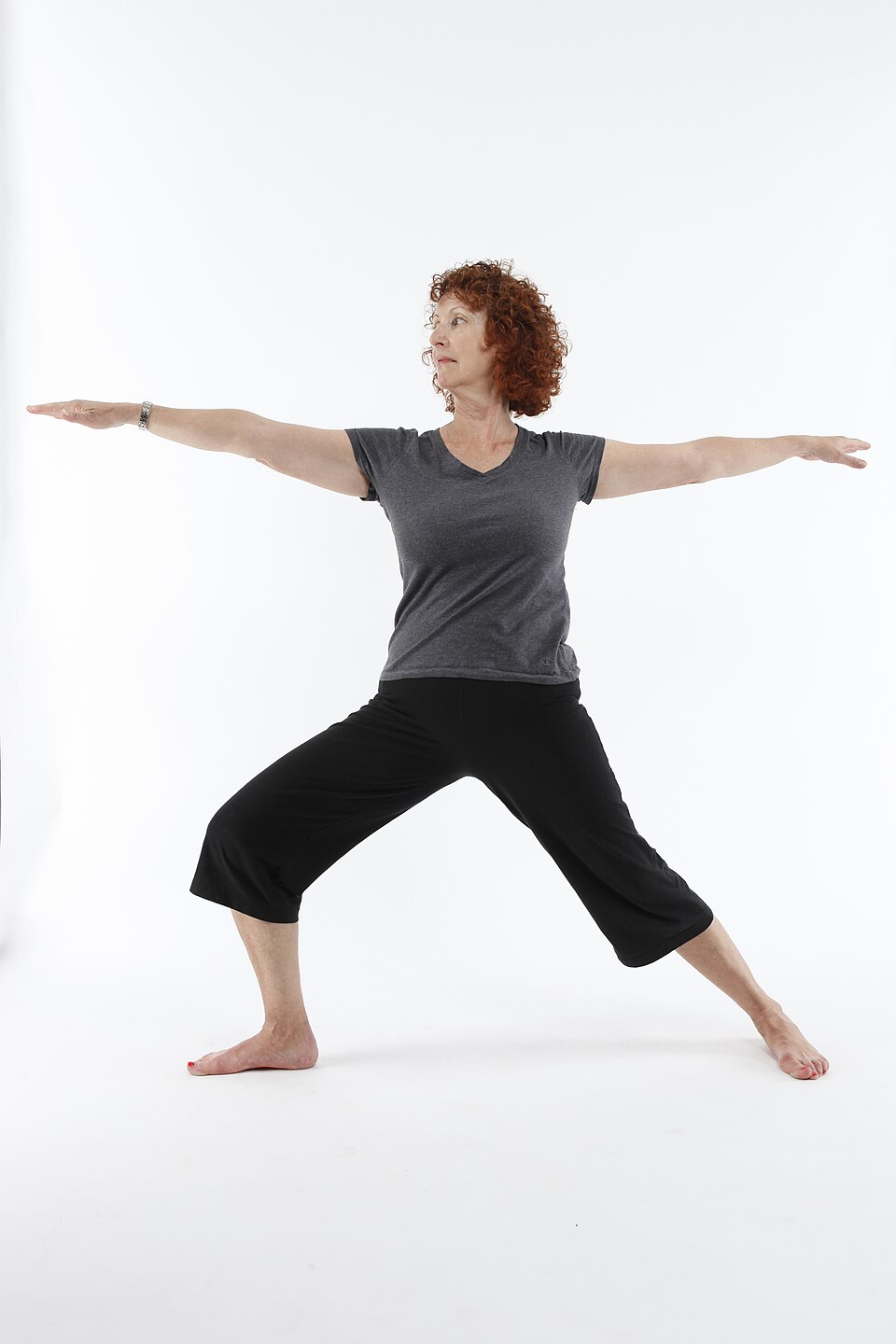
Virabhadrasana II — Warrior II — is a strong, grounding standing pose that builds stamina in the legs and openness across the chest. Named after a fierce warrior of Indian myth, it teaches steady power with a soft, focused gaze.
Name meaning: From Vīrabhadra, a fierce warrior of Hindu myth born from Shiva, and āsana meaning "posture" — the "warrior posture", second form.
Classification: Asana — a wide-stance standing strength pose.
Tradition & origin: Although named for the myth of Virabhadra, the Warrior poses are not recorded in the medieval hatha-yoga texts; they appear only in the 20th century through Krishnamacharya and his student Pattabhi Jois (photographed in Warrior around 1939). Scholars note similarities to early-20th-century gymnastics, so it is best presented as modern postural yoga with a mythological name, not an ancient asana.
This guide was drafted with the help of AI and reviewed by us. It is for general education only and is not medical or professional advice. It may contain errors. Please practise mindfully, listen to your body, and consult a qualified yoga teacher or doctor for anything specific. Spotted an error? Tell us in the comments below.
How to do it — step by step
- 1Step the feet wide apart, arms out to the sides at shoulder height.
- 2Turn the front foot out 90°; angle the back foot slightly in.
- 3Line up the front heel with the arch of the back foot.
- 4Bend the front knee toward 90°, tracking over the ankle (not past the toes).
- 5Keep the torso upright and centred over the hips — do not lean forward.
- 6Reach strongly through both arms, shoulders relaxed.
- 7Gaze softly over the front middle finger.
Breath & hold
Breathe fully and steadily. Hold for 30–45 seconds each side, keeping the back leg strong throughout.
Benefits
- ✓Strengthens the legs, glutes and ankles.
- ✓Opens the hips and chest.
- ✓Builds stamina and focus.
- ✓Encourages steady, powerful breathing.
🪔 The traditional / desi way
- Virabhadra was a mighty warrior born from Shiva — the pose embodies fierce strength held with composure.
- Traditional cue: strong legs, soft face. The warrior is powerful yet unshaken, gaze quiet as a candle flame.
Common mistakes
- ✕Letting the front knee collapse inward — track it toward the little toe.
- ✕Leaning the torso over the front leg.
- ✕Letting the back leg go soft and the arch drop.
- ✕Hiking the shoulders up toward the ears.
Modifications & props
- 🧩Shorten the stance for more stability.
- 🧩Rest the back against a wall to learn an upright torso.
Muscles & anatomy
- 💪Working: quadriceps and glutes of the front leg; adductors and the whole standing base; shoulders hold the arms out.
- 💪Stretched: the inner thighs and the front hip of the back leg; the chest opens.
- 💪Stabilising: the back-leg foot arch and the core keep the torso upright.
What you may feel
- 🫧Normal: strong effort in the front thigh, a wide stretch through the inner legs, and steady arms.
- 🫧Normal: warmth and some shaking in the legs on longer holds.
- 🫧Warning sign: knee pain or the knee caving inward — ease up and realign over the ankle.
Variations to grow into
Deepen toward a right-angle front knee and lengthen the hold, keeping the torso stacked over the hips.
Flow between Warrior II, Reverse Warrior and Extended Side Angle to build strength and mobility in sequence.
Using props
- 🧱A wall behind the back to learn an upright torso.
- 🧱A block under the front thigh (against a wall) to rest into the shape while learning.
Warm-up & counterpose
- A few Sun-Salutation rounds or gentle lunges to warm the legs.
- Hip circles and ankle mobility.
- A forward fold or a wide-legged forward bend to release the legs.
- Gentle standing side-stretches to balance the effort.
Supporting exercises
Why: Builds the leg endurance the pose needs.
How: With the back to a wall, sink into a wide, bent-knee stance and hold 20–40 seconds.
Why: Frees the hips for a more comfortable wide stance.
How: Cross one ankle over the opposite thigh and sit back slightly; hold 20–30 seconds each side near support.
Progression path
Begin with a shorter stance and a shallow bend, lengthening both as leg strength and hip openness grow. Add flowing transitions once the static hold feels stable.
Who it suits — and who should modify
- ✓Beginners building leg strength (shorten the stance as needed).
- ✓Most intermediate practitioners as a staple standing pose.
- ✓Anyone wanting to build stamina and hip/chest openness.
- !Modify: knee injury — reduce the depth of the front-knee bend and keep it tracking over the ankle.
- !Modify: hip or shoulder injury — shorten the stance and lower the arms.
- !Relative caution: balance or blood-pressure issues — stand shorter and rest a hand near support.
When to practise
Any time; often placed in the standing section of a practice once the body is warm.
Safe to practise regularly; a few holds per side is enough to build strength.
Traditional view vs. modern evidence
Embodies the fierce-yet-composed warrior Virabhadra — strong legs, soft focused gaze.
Not found in medieval hatha texts; a 20th-century pose with a mythological name.
Valued for leg strength, hip and chest opening, and stamina.
Any claim of ancient scriptural origin for the posture itself is unsupported.
Evidence at a glance
Standing strength poses build lower-body strength and endurance.
Consistent with exercise-physiology evidence for loaded, sustained leg work.
Yoga can support balance and general fitness.
Balance/wellbeing benefits noted by NCCIH for yoga overall.
Myths vs. reality
✕ Myth: Warrior II is an ancient posture from the scriptures.
✓ Reality: Its name comes from myth, but the pose itself is modern (20th century). This does not lessen its value — just its claimed antiquity.
✕ Myth: The deeper the lunge, the better.
✓ Reality: Depth matters less than the knee tracking safely over the ankle and an upright, steady torso.
⚠️ Cautions
- Knee, hip or shoulder injuries — reduce the depth of the bend and lower the arms.
Frequently asked questions
How deep should the front knee bend?
Aim toward 90° with the thigh parallel to the floor, but only as far as you can keep the knee over the ankle. Build up gradually.
Warrior I vs Warrior II?
Warrior I faces the front with hips squared and arms overhead; Warrior II opens to the side with arms wide and gaze over the front hand.
Key takeaways
- ⭐A grounding standing pose that builds leg strength and opens the hips and chest.
- ⭐Keep the front knee over the ankle and the torso upright.
- ⭐Modern postural yoga with a mythological name — not an ancient asana.
- ⭐Shorten the stance to modify for knees, hips or balance.
References
- Wikipedia — Virabhadrasana (etymology & origins, sourced to Singleton, Yoga Body) · Encyclopaedia, scholarly-sourced
- NCCIH — Yoga: What You Need To Know · Government health body (public domain)
Sources are provided for further reading; always consult a qualified teacher or clinician for personal guidance.
📝 Your private notes
Saved only on this device — jot down what helped.
💬 Improvements, corrections & suggestions
Found an error or have a better cue? Share it — practitioners help make each guide more accurate.
No comments yet — be the first to help improve this guide.