DAILY YOGA · Virabhadrasana III
Warrior III
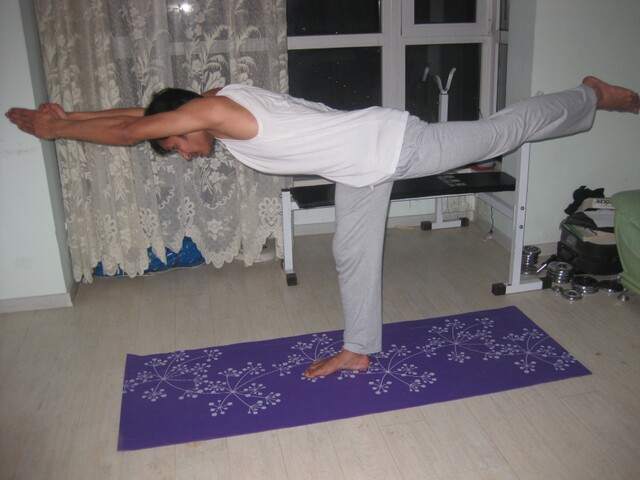
Virabhadrasana III — Warrior III — is a challenging standing balance where the body tips forward into a straight, horizontal line balanced on one leg. It builds powerful legs, a strong core and sharp focus — the warrior in flight.
Name meaning: Named after Virabhadra, a fierce warrior created by Shiva, plus "asana" (pose). "III" marks the third of the three modern Warrior poses — here the balancing, forward-tipping expression.
Classification: Asana — a standing one-legged balance.
Tradition & origin: The Virabhadrasana series belongs to modern postural yoga; the three numbered Warriors were codified and popularised in the 20th century (notably through the Iyengar and Ashtanga lineages). The warrior Virabhadra comes from Hindu mythology, but the numbered postures themselves are a modern arrangement.
This guide was drafted with the help of AI and reviewed by us. It is for general education only and is not medical or professional advice. It may contain errors. Please practise mindfully, listen to your body, and consult a qualified yoga teacher or doctor for anything specific. Spotted an error? Tell us in the comments below.
How to do it — step by step
- 1From a lunge or Warrior I, shift the weight onto the front foot.
- 2Reach the arms forward and begin to tip the torso down.
- 3Lift the back leg up behind you until it is parallel to the floor.
- 4Form one straight line from the reaching hands to the lifted heel.
- 5Keep the hips level and the standing leg strong (knee soft, not locked).
- 6Flex the lifted foot and reach back through the heel.
- 7Gaze at the floor a little ahead; then step back with control.
Breath & hold
Breathe steadily; hold 15–30 seconds each side. A steady breath keeps the balance calm.
Benefits
- ✓Strengthens the legs, glutes, back and core.
- ✓Improves balance and concentration.
- ✓Tones the whole posterior chain.
- ✓Builds full-body coordination.
🪔 The traditional / desi way
- The warrior in motion — where Warrior I and II are grounded stances, this is the warrior mid-stride, poised and focused.
- Traditional cue: reach in two directions at once — hands forward, heel back — so the body lengthens rather than collapses.
Common mistakes
- ✕Letting the lifted hip open toward the ceiling (keep hips level).
- ✕Locking the standing knee.
- ✕Dropping the chest and lifting the leg unevenly.
Modifications & props
- 🧩Rest the hands on a wall or chair-back for support.
- 🧩Keep the arms back alongside the body (easier balance).
- 🧩Lift the back leg only partway.
Muscles & anatomy
- 💪Strengthens: standing-leg quadriceps, hamstrings and gluteals; the core and spinal extensors.
- 💪Works: the ankle stabilisers of the standing foot and the upper-back muscles.
- 💪Stretches: the hamstring of the standing leg as it supports the tilt.
What you may feel
- 🫧Normal: strong effort in the standing-leg glute, hamstring and core; a lengthening from fingertips to lifted heel.
- 🫧Warning: pain in the standing knee (soften it) or the lower back (lift the belly and level the hips) — come out if it persists.
Variations to grow into
Take the arms forward past the ears in a full straight line and hold longer with a steady gaze, free of the wall.
Flow in and out of Warrior III from Warrior I or a standing balance, or transition to Ardha Chandrasana — only with reliable balance.
Using props
- 🧱A wall or chair-back under the hands for a stable, supported version.
- 🧱A block under the lower hand if practising near the floor.
Warm-up & counterpose
- Warrior I and II, and standing Hand-to-Big-Toe to wake the standing-leg and balance.
- A few rounds of Sun Salutations to warm the hips and hamstrings.
- Tadasana to re-centre, then a gentle standing forward fold to release the standing leg.
Progression path
Begin with hands on a wall and the back leg lifted only partway; progress by lowering the torso and lifting the leg to horizontal, then release the wall as balance improves.
Who it suits — and who should modify
- ✓Intermediate practitioners with basic standing balance.
- ✓Beginners using a wall or chair for support.
- ✓Anyone building leg strength, balance, and focus.
- !Relative: low blood pressure or balance disorders — use a wall or chair under the hands.
- !Relative: ankle, knee, or hamstring injury of the standing leg — build strength first and keep the knee soft.
- !Relative: recent hip or back injury — reduce the tilt and lift.
When to practise
Good in an active daytime or morning practice when you are warm and alert; the balance and focus it needs suit a wakeful, energised session.
Two to four times a week within a standing-pose practice; hold 15–30 seconds each side.
Traditional view vs. modern evidence
The warrior "in flight" — poised, focused, reaching in two directions at once.
A modern posture; the numbered Warrior series is not found in the medieval hatha texts.
An effective strength-and-balance pose for the posterior chain and core.
Specific cognitive or "willpower" benefits beyond the focus balance requires are not established.
Evidence at a glance
Balancing poses can improve balance and lower-limb strength.
Balance training generally improves balance; yoga balance poses are consistent with this.
Warrior III improves focus and concentration.
Sustained balance clearly demands focus; broader cognitive claims are not well studied.
Myths vs. reality
✕ Myth: Your lifted leg must be perfectly parallel or higher than your torso.
✓ Reality: A level, square-hipped line matters more than height. Lifting the leg too high usually just opens the hip and twists the spine.
✕ Myth: Balance is purely about strong legs.
✓ Reality: Steady gaze (drishti), even breath, and core engagement matter as much as leg strength.
⚠️ Cautions
- Low blood pressure or balance issues — use a wall or chair under the hands.
Frequently asked questions
How do I stop wobbling?
Fix your gaze on the floor ahead, root through the standing foot, and reach actively hands-forward and heel-back to create length and stability.
Where should I feel it?
The standing-leg glute and hamstring, plus the core and upper back — not the lower back.
Key takeaways
- ⭐A one-legged standing balance forming a straight line from hands to lifted heel.
- ⭐Keep the hips level and the standing knee soft — never locked.
- ⭐A modern posture; the mythic warrior is ancient but the numbered poses are 20th-century.
- ⭐Use a wall or chair for support while building balance.
References
- Yoga: What You Need To Know — NCCIH · health authority (public domain)
- Virabhadrasana — Wikipedia · encyclopedia
Sources are provided for further reading; always consult a qualified teacher or clinician for personal guidance.
📝 Your private notes
Saved only on this device — jot down what helped.
💬 Improvements, corrections & suggestions
Found an error or have a better cue? Share it — practitioners help make each guide more accurate.
No comments yet — be the first to help improve this guide.