DAILY YOGA · Vrschikasana
Scorpion Pose
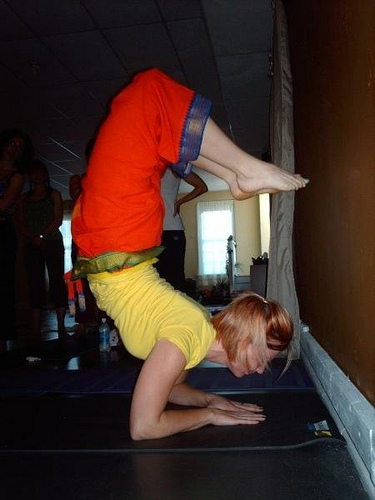
Vrschikasana — Scorpion Pose — is an advanced forearm-balance backbend where the legs bend overhead toward the head, arching like a scorpion's raised tail and sting. It combines a Forearm Stand with a deep backbend, demanding strong shoulders, an open spine and a fearless, patient approach.
Name meaning: From vṛścika meaning "scorpion", and āsana — the "scorpion posture", the arched body with the feet reaching toward the head resembling a scorpion's raised, curling tail.
Classification: Asana — an advanced inversion combining a forearm balance with a deep backbend.
Tradition & origin: Scorpion is modern: it is not found in the medieval hatha texts and is described in 20th-century manuals such as Iyengar's Light on Yoga (which grades it very advanced). Present it as modern postural yoga.
This guide was drafted with the help of AI and reviewed by us. It is for general education only and is not medical or professional advice. It may contain errors. Please practise mindfully, listen to your body, and consult a qualified yoga teacher or doctor for anything specific. Spotted an error? Tell us in the comments below.
How to do it — step by step
- 1Establish a steady Forearm Stand (Pincha Mayurasana) at a wall.
- 2Keep the forearms firmly pressed and the elbows shoulder-width.
- 3Lift the head and gaze forward, opening the chest.
- 4Begin to bend the knees and arch the upper back.
- 5Slowly lower the feet toward (or over) the head, keeping control.
- 6Keep pressing the forearms down to protect the shoulders and neck.
- 7Come out with control, one movement at a time; rest.
Breath & hold
Breathe steadily; hold only briefly and build up. Never hold the breath.
Benefits
- ✓Deeply opens the chest, shoulders and spine.
- ✓Builds strong shoulders, arms and back.
- ✓Develops balance, focus and confidence.
- ✓An advanced union of inversion and backbend.
🪔 The traditional / desi way
- The scorpion (vrschika) arches its tail to strike — the bent legs curving toward the head mirror that dramatic shape.
- Traditional wisdom: master Forearm Stand and deep backbends separately, over a long time, before combining them. The foundation and patience are everything.
Common mistakes
- ✕Attempting it before Forearm Stand and backbends are solid.
- ✕Letting the elbows splay and the shoulders collapse.
- ✕Dropping into the backbend without control.
Modifications & props
- 🧩Practise at a wall.
- 🧩Build Forearm Stand strength and backbend openness (Camel, Wheel) separately first.
Muscles & anatomy
- 💪Demands strong shoulders, upper back and core for the forearm balance.
- 💪Requires a deep, mobile backbend through the whole spine.
- 💪The shoulders and neck bear real load — strength and control are essential.
What you may feel
- 🫧Normal: intense whole-body effort — a balancing forearm base and a deep spinal arch.
- 🫧Warning sign: any neck or lower-back pinch, or loss of control — come down immediately; this pose is unforgiving.
Variations to grow into
Work a steady Forearm Stand and, separately, deep backbends (Camel, Wheel, King Pigeon) before combining them.
The straight-arm (handstand-based) Scorpion (Vrischikasana II) — an extremely difficult balance for elite practitioners.
Using props
- 🧱A wall to catch the feet and control the backbend.
- 🧱A spotter or teacher while learning.
Warm-up & counterpose
- Thorough shoulder, spine and backbend preparation, plus Forearm Stand.
- Child's Pose and a gentle forward fold to release the spine and shoulders.
Supporting exercises
Why: Builds the balancing base Scorpion needs.
How: Hold a steady forearm balance at a wall.
Why: Open the spine and shoulders for the deep arch.
How: Practise these separately over months.
Progression path
Build a rock-solid Forearm Stand and deep, comfortable backbends over months; only then combine them slowly at a wall with a teacher.
Who it suits — and who should modify
- ✓Advanced practitioners with a strong, steady Forearm Stand and open backbends.
- ✓Those with strong shoulders and a mobile spine, working patiently at a wall.
- ✓People who can already fall safely from inversions.
- !Neck, shoulder, wrist or back injury — build strength and openness first or skip.
- !High blood pressure, glaucoma, heart conditions, pregnancy — avoid inversions (traditional guidance).
- !Beginners or anyone without a solid Forearm Stand and deep backbend — not yet.
When to practise
In the strongest, most warmed part of a practice, after backbend and inversion preparation.
Occasionally, for experienced practitioners; build over months.
Traditional view vs. modern evidence
The scorpion's curling tail; in Iyengar's framing, subduing the ego's "deadly" emotions.
Not in the medieval texts; a 20th-century pose (Light on Yoga).
Valued as an elite strength-and-backbend inversion.
Ego-dissolving and therapeutic claims are not established.
Evidence at a glance
Scorpion demands and builds shoulder/back strength, balance and spinal mobility.
Consistent with the biomechanics of an advanced backbend inversion.
It has special therapeutic or ego-dissolving effects.
Symbolic claims without supporting evidence.
Myths vs. reality
✕ Myth: Scorpion "subjugates the ego".
✓ Reality: Iyengar offered that poetic framing; it is symbolism, not a physiological effect. The pose is simply a very advanced strength-and-backbend balance.
✕ Myth: You can rush it with enough flexibility.
✓ Reality: It demands strength, control and safe-falling ability as much as flexibility; rushing risks the neck and back.
⚠️ Cautions
- Shoulder, neck, wrist or back injury, high blood pressure, or pregnancy — avoid. This is an advanced pose; learn only with a teacher and a wall.
Frequently asked questions
How do I work toward Scorpion?
Build a steady, strong Forearm Stand and open your backbends (Camel, Wheel, King Pigeon) over months. Then combine them slowly at a wall with a teacher.
Is it safe for the neck?
It places real demand on the neck and shoulders — only attempt it with a solid foundation and guidance; skip it if you have any neck issue.
Key takeaways
- ⭐An elite inversion combining a forearm balance with a deep backbend.
- ⭐Build a solid Forearm Stand and deep backbends separately over months first.
- ⭐Real neck/back load — learn at a wall with a teacher; skip with any neck issue.
- ⭐A modern pose (Light on Yoga).
References
- Wikipedia — Scorpion pose / Vrischikasana (origins, Light on Yoga) · Encyclopaedia, scholarly-sourced
- NCCIH — Yoga: What You Need To Know · Government health body (public domain)
Sources are provided for further reading; always consult a qualified teacher or clinician for personal guidance.
📝 Your private notes
Saved only on this device — jot down what helped.
💬 Improvements, corrections & suggestions
Found an error or have a better cue? Share it — practitioners help make each guide more accurate.
No comments yet — be the first to help improve this guide.